Why Boise and Meridian Water Is So Hard (and Why It Matters)
If you have lived in the Treasure Valley for more than a few months, you have probably noticed it: the white crust around your faucets, the filmy residue on your shower glass, the dishes that come out of the dishwasher looking worse than they went in. That is hard water at work, and it is not a minor inconvenience. It is a measurable problem that shortens the life of your water heater, clogs your pipes, and costs you money every month.
The geology of the Treasure Valley is largely to blame. Boise and its surrounding communities sit atop ancient alluvial and sedimentary formations carved out by the Boise River watershed over thousands of years. As groundwater moves through those calcium- and magnesium-rich layers, it picks up minerals before it ever reaches your tap. The result: Boise city water typically tests between 10 and 15 grains per gallon (gpg). Meridian, drawing from a slightly different portion of the aquifer, commonly lands between 12 and 17 gpg. For context, water above 10.5 gpg is classified as "very hard" by the USGS.
The stakes are rising alongside the population. A March 2026 Boise State University study on the Treasure Valley's energy-water future flagged serious supply constraints on the horizon as the metro absorbs over 150,000 new residents this decade. The Idaho Department of Water Resources has already run stress tests on local groundwater models, and the findings are sobering. Every gallon matters more now than it did five years ago. That makes the choice between a salt-based softener and a salt-free conditioner more than a household preference question. It is a decision with real environmental weight.
What a Salt-Based Water Softener Does for Boise Homes
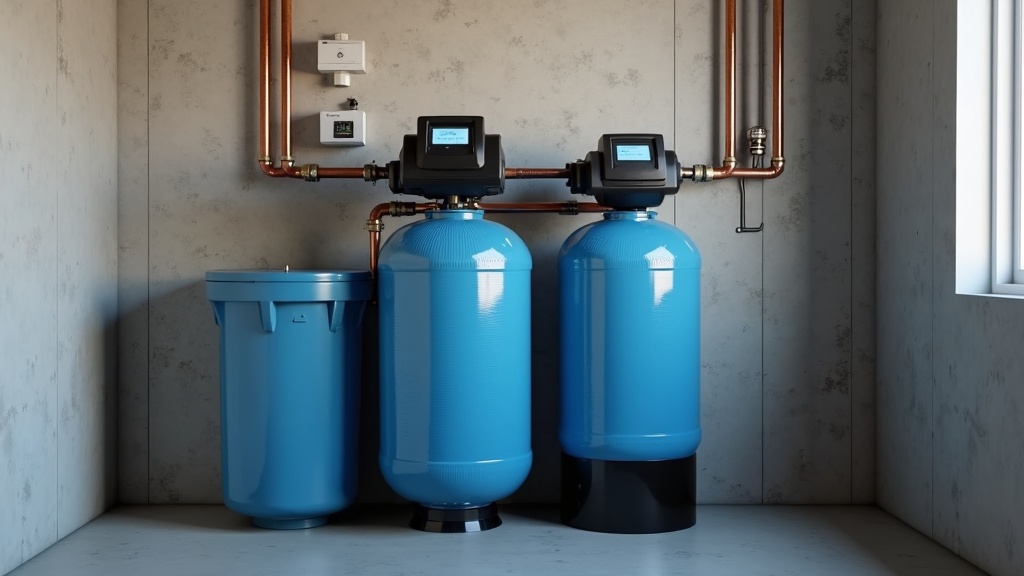
A salt-based water softener uses a process called ion exchange. As hard water flows through a resin tank filled with sodium-charged beads, the calcium and magnesium ions attach to the resin and sodium ions are released in their place. The water coming out of the other end has been genuinely softened, typically dropping to 0 gpg. Your skin feels different in the shower. Your dishes come out clean. Your water heater stops accumulating scale.
The tradeoff is maintenance. Salt-based systems require you to refill the brine tank with 40 to 80 pound bags of salt every four to eight weeks depending on household size and water hardness. They also need a drain connection for backwash cycles, a small amount of electricity, and periodic resin cleaning. In a high-hardness area like Meridian, your system will regenerate more frequently than the same unit would in a softer-water city.
Salt-based softeners are the right call when your hardness is above 10 gpg (which covers most of the Treasure Valley), when you or your family struggle with dry skin and brittle hair from mineral-heavy water, or when you are protecting new appliances and a water heater you would like to last 15 years instead of 8.
What a Salt-Free Water Conditioner Does (and What It Does Not)
Salt-free systems, often called water conditioners, use a technology called Template Assisted Crystallization, or TAC. Instead of removing calcium and magnesium from the water, TAC media causes those minerals to form microscopic crystals that stay suspended in the water rather than bonding to your pipes and fixtures. The minerals are still present; they just cannot stick.
The practical upside is real. You get meaningful scale prevention with no salt, no electricity, no drain connection, and no backwash waste water. There is no sodium added to the water, which matters for people on low-sodium diets. And from an environmental standpoint, you are not discharging brine into the municipal wastewater system, which is a genuine advantage as regional water systems face growing pressure.
The honest limitation: salt-free systems do not soften water. Your hardness reading stays the same. The silky feel of truly softened water does not happen. Soap still lathers differently than it would with a salt-based system. And at 12 to 17 gpg, Meridian homes are at or near the top of the effective range for TAC technology. Most manufacturers rate their salt-free systems up to 25 gpg, but performance in very hard water is noticeably less consistent than in the 5 to 10 gpg range where these systems shine brightest.
Side-by-Side Comparison for Treasure Valley Homeowners
| Factor | Salt-Based Softener | Salt-Free Conditioner |
|---|---|---|
| Hardness removal | Yes, reduces to 0 gpg | No, minerals remain |
| Scale prevention | Excellent | Good (best below 10 gpg) |
| Skin and hair feel | Noticeably softer | No change |
| Maintenance | Salt refills every 4-8 weeks | Media replacement every 3-5 years |
| Water waste | Some (backwash cycle) | None |
| Sodium in water | Small amount added | None added |
| Environmental footprint | Brine discharge; modern units minimized | No discharge |
| Ideal hardness range | Any hardness; essential above 10 gpg | Best at 0-10 gpg; usable to 25 gpg |
| Electricity needed | Yes | No |
For most Boise and Meridian homeowners at 10 to 17 gpg, the salt-based system wins on performance. The salt-free conditioner earns its place in homes with lower hardness, renters who cannot install a drain connection, or households with specific sodium concerns.
Common Myths About Salt-Free Water Softeners in Boise (Debunked)
We field a lot of questions about salt-free systems, and there is genuine confusion in the market. Here is a straight answer to the claims we hear most often.
Myth 1: Salt-free is just as effective as salt-based.
Not at Treasure Valley hardness levels. TAC technology is well-documented for scale prevention, but it does not remove minerals from the water. At 12 to 17 gpg, a salt-based softener will consistently outperform a conditioner for pipe protection, appliance longevity, and the tactile experience of softened water.
Myth 2: A salt-based softener makes your water taste salty.
The amount of sodium added by ion exchange is small, typically 20 to 50 milligrams per liter depending on your starting hardness. For comparison, a slice of white bread contains around 150 milligrams of sodium. Most people cannot taste the difference. If sodium is a medical concern for someone in your household, a reverse osmosis system on the drinking water tap addresses it cleanly.
Myth 3: Salt-free systems are completely maintenance-free.
They are lower maintenance, not zero maintenance. TAC media exhausts over time and needs to be replaced every three to five years. Skipping that replacement means the system quietly stops working while you assume it is still protecting your pipes.
Myth 4: Salt-free is always the environmentally responsible choice.
Mostly true, but the gap is narrowing. Modern demand-initiated salt-based systems only regenerate when needed based on actual water usage, significantly reducing brine discharge compared to older timer-based units. If you are upgrading from a 15-year-old softener, a current-generation unit is far more efficient than what you might be picturing.
Myth 5: Either system handles iron in well water.
Neither one does, on its own. If your well water in Canyon County or rural Ada County has iron above 0.3 parts per million, you need a dedicated iron pre-filter before any softener or conditioner. Iron will foul resin beads and ruin a salt-based system surprisingly fast. We always recommend a water test before recommending any equipment. The EPA's drinking water guidance is a solid starting point for understanding what to test for.
How to Choose Between Salt-Based and Salt-Free for Your Boise-Area Home
There is no universal right answer, but there is a right answer for your specific situation. Here is how we walk through it with customers.
Step 1: Know your water.
We offer free water testing across the Treasure Valley. A 10-minute test tells you your hardness, iron levels, pH, and total dissolved solids. Without that baseline, any equipment recommendation is a guess. If you are on city water in Boise or Meridian, we can also pull historical water quality data to give you a reliable starting point.
Step 2: Know your priorities.
Are you primarily trying to protect appliances and plumbing? Both systems help. Do you want soft-feeling water for skin and hair? You need a salt-based softener. Is sodium a dietary concern, or do you want zero environmental discharge? A salt-free conditioner may fit better, especially if your hardness is on the lower end of the Boise range.
Step 3: Consider your plumbing setup.
Salt-based softeners require a drain connection nearby and a power outlet. Salt-free conditioners need neither, making them easier to install in utility closets, crawl spaces, or anywhere drain access is limited.
Step 4: Check HOA or municipal rules.
Some Idaho municipalities and a handful of HOAs in newer Meridian and Eagle subdivisions have guidelines around water softener discharge. It is worth a quick check before you commit to a salt-based system. Our team can help you look into local requirements.
Step 5: Think long-term cost.
Salt costs roughly $10 to $25 per bag, and most Treasure Valley households go through 10 to 15 bags per year. That is $100 to $375 annually in salt alone, plus occasional resin cleaning and system service. Salt-free systems have lower ongoing costs but a higher replacement media expense every few years. Over a 10-year window, the two are often closer in total cost than people expect. We put together a full breakdown in our 2026 guide to the best water softeners for Boise homeowners if you want to run the numbers for your household size.
Frequently Asked Questions
Ready to Find Out What Your Water Actually Needs?
We test water across the Treasure Valley at no charge. Bring us a sample or schedule a visit to your home in Boise, Meridian, Nampa, Eagle, Caldwell, or anywhere in between. We will tell you exactly what is in your water, explain your options honestly, and give you a clear recommendation without the sales pressure.
The TrueWater team installs and services both salt-based and salt-free systems. We are not tied to one brand or one approach. We tell you what makes sense for your water, your home, and your budget.