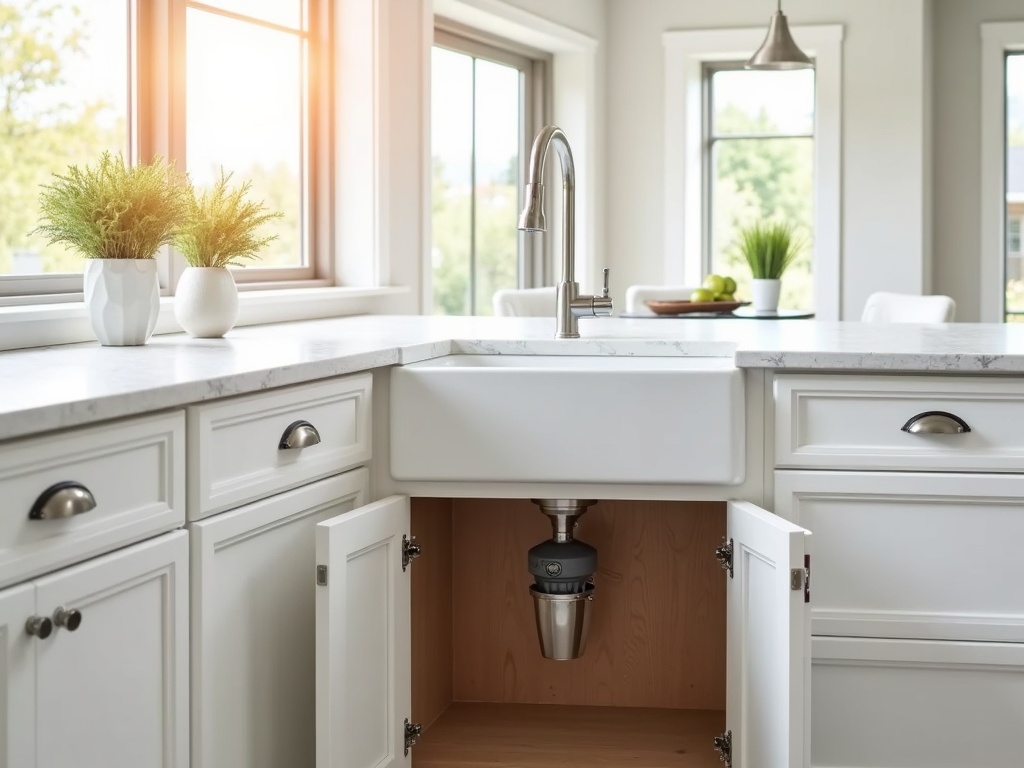
If you live in Boise, Meridian, Eagle, or anywhere else in the Treasure Valley, your garbage disposal is working harder than most homeowners realize. It is not just the food scraps. It is the water itself. At 10-15 grains per gallon (gpg) in Boise and up to 17 gpg in parts of Meridian, local tap water carries enough dissolved calcium and magnesium to leave a slow, steady layer of mineral scale on every surface inside that grinding chamber. Over months and years, that scale shortens your disposal's life, reduces its efficiency, and eventually forces a replacement years ahead of schedule.
We see this pattern constantly across Ada County, and summer 2026 has added a new layer to the problem.
Why Boise's Water Is Already Hard on Your Disposal
The USGS classifies water above 7 gpg as hard. The national average runs 4-7 gpg. Here in the Treasure Valley, we are well above that baseline in every city we serve:
- Boise: 10-15 gpg
- Meridian: 12-17 gpg
- Eagle: 13-16 gpg
- Nampa, Star, Kuna: similarly elevated
The reason is geology. The Snake River Plain sits on a massive basalt aquifer, and water percolating through calcium and magnesium-rich volcanic rock picks up those minerals before it ever reaches a treatment facility or a well pump. That is not a water quality failure. It is just what the ground here is made of. The USGS water hardness data and Idaho DEQ water quality reports both confirm what we measure in homes every week.
Now consider what a garbage disposal actually does. It processes food waste with water running continuously, cycling mineral-laden water through the grinding chamber dozens of times per week. No other under-sink appliance accumulates scale as efficiently. A dishwasher runs once a day. A faucet runs for seconds at a time. A disposal grinds, churns, and holds warm, turbulent water against metal surfaces repeatedly. To put it in concrete terms: a Seattle home at 0.3 gpg versus a Meridian home at 15 gpg sees roughly 50 times the mineral load per gallon. That gap compounds over years.
The 2026 Drought Effect: How Summer Makes It Worse
In July 2026, the City of Boise adopted a Drought Emergency Ordinance following near-record-low snowpack across the region. Summer water demand nearly tripled on the public system, straining surface water supplies. What most homeowners do not know is how a drought emergency changes what comes out of the tap. When reservoir and surface water inputs shrink, the city draws more heavily from groundwater wells. And groundwater pulled from the basalt aquifer carries higher dissolved mineral concentrations than treated surface water. Our Boise drought ordinance article covers the water quality implications in more detail.
The practical result: your disposal is already accumulating scale year-round, and now it is processing measurably harder water during July and August, the months when it is also working its hardest. Summer BBQs, garden harvests, and holiday weekends put more food waste through the disposal than any other time of year. Harder water plus peak use equals accelerated damage. There is also an irony worth noting: a disposal that has already been degraded by scale runs water longer to flush food waste effectively. That extra water use adds to the exact strain on the municipal system that the drought ordinance was designed to reduce.
How Hard Water Actually Damages a Garbage Disposal
The Grinding Chamber
The two working surfaces in any disposal are the impeller plate (the rotating disc that spins food into the outer ring) and the shredder ring (the stationary toothed ring that does the actual grinding). Both accumulate calcium and magnesium deposits with every use. Scale on the impeller reduces grip and effective surface area. The motor compensates by working harder to achieve the same result, and that extra load shortens motor life directly. The shredder ring develops a calcium crust that reduces grinding efficiency and leaves larger food particles in the drain channel.
There is also a specific mechanical issue in disposals that does not apply to pipes: the grinding action physically cracks mineral deposits and sends calcium fragments into the drain. Pipes just accumulate scale inward. Disposals fracture it, creating fine calcium grit that accelerates wear on moving parts.
The Drain Channel
A quarter-inch of scale in the narrow drain channel below the disposal is enough to restrict flow noticeably. Slower clearing means standing water in the chamber between uses, which creates odor and provides a surface for additional mineral bonding. The P-trap directly below the disposal collects calcium faster than traps elsewhere in the home because the effluent coming out of a disposal is warm and turbulent, two conditions that accelerate mineral precipitation. When scale combines with food grease, you get a reliable clog combination that often shows up as a drain backup rather than a disposal malfunction.
The Rubber Splash Guard
This is the part most homeowners overlook. The rubber splash guard at the drain opening goes through constant wet-dry cycling, and in hard water areas that means a granular mineral crust forms on its surface repeatedly. Unlike metal, rubber is mechanically abraded by that mineral crust each time the disposal runs. The guard stiffens over time, cracks around its perimeter slots, and eventually stops sealing properly. A replacement guard costs $10-25 and takes ten minutes to install, but most homeowners never connect a stiff, cracked splash guard to hard water. They assume it is just old rubber.
Motor Housing and Heat
Scale that builds up around the motor housing and on bearing surfaces acts as an insulating layer. The motor runs hotter than it was designed to, and the thermal reset button trips more frequently during or after normal use. If you are hitting the red reset button on the bottom of your disposal regularly, thermal stress from scale-insulated components is often the cause. At 12-17 gpg with multiple grinding cycles per day, motor failure from accumulated thermal stress is the most common reason we see disposals fail well before their rated lifespan. You can read more about how this fits the broader pattern of hard water and appliance lifespan across Treasure Valley homes.
Lifespan Impact and What Replacement Costs in Ada County
Expected vs. Real Lifespan in Boise
InSinkErator's Badger series carries a 2-5 year warranty. The Evolution series is rated 9-10 years. Both ratings assume operation at the national average water hardness of 4-7 gpg. In the TrueWater service area, homeowners on untreated Boise-area water consistently report failures in the 4-7 year range, roughly 30-40% ahead of rated life. That tracks with Water Quality Association research on hard water's effect on appliance longevity. For units already 3-5 years old, the higher mineral concentrations of a drought summer may push failure timelines earlier still.
Replacement and Repair Costs in Ada County
Here is what you can expect to pay for disposal service in the Boise area:
- Repair (jam clearing, reset, small parts): $116-$267 per visit; Idaho plumber rates track national averages given Boise metro growth
- InSinkErator Badger 1 (1/3 HP): ~$129 unit cost
- InSinkErator Badger 5 (1/2 HP): ~$149 unit cost
- InSinkErator Evolution .75 HP: ~$299 unit cost
- InSinkErator Evolution 1.0 HP: ~$349 unit cost
- Installation labor in Ada County: $150-$250 for a standard swap
- Mid-range full replacement total: $280-$600 installed
- Premium Evolution installed: $450-$700
The math on "I'll just keep repairing it" breaks down quickly. Three repair calls over four years at $150-$200 each adds up to $450-$600 spent on a unit that still needs replacing. A new mid-range disposal installed is often less expensive than that repair history.
The New Construction Trap
Meridian, Star, and Eagle are adding thousands of new homes every year. Builders install a Badger 1 or equivalent entry-level unit as standard, typically 1/3 HP with a two-year warranty. Buyers move in, use the disposal normally, and hit the end of the warranty period at almost exactly the same time two years of hard water scale has accumulated on the grinding surfaces. A disposal failure in a home that is only two years old is one of the most common service calls we handle. The unit was not defective. It was undersized for Treasure Valley water conditions from day one. We cover the same builder gap in our dishwasher hard water damage article.
Signs Your Boise Disposal Has Hard Water Damage
These are the patterns we see most consistently in homes across Boise, Meridian, Nampa, and Kuna:
- Longer grinding cycle needed to process the same amount of food waste as it handled easily a year ago
- Humming without grinding, even after hitting the reset button on the bottom of the unit
- Persistent drain odor even after cleaning with ice and citrus
- Frequent thermal reset button trips during or immediately after normal use
- White or gray crust visible on the underside of the splash guard or inside the drain opening
- Drain clearing noticeably slower in July-August compared to January-March (seasonal mineral concentration is a real and measurable difference)
If you are seeing two or more of these, the disposal has likely accumulated significant scale and is operating under increased thermal and mechanical stress. The question is whether to repair, replace, or address the water quality causing the damage in the first place.
What You Can Do About It
Short-Term: Slow the Damage
There are a few maintenance habits that help at Treasure Valley hardness levels. They will not stop mineral accumulation, but they can extend the interval between problems:
- Monthly ice-and-coarse-salt grind: Fill the disposal with ice and a cup of kosher or rock salt (not table salt), then run it. The combination mechanically scours the impeller and grind ring surfaces, breaking up early-stage deposits before they harden fully.
- White vinegar ice cubes: Freeze white vinegar in an ice cube tray and run a tray through the disposal monthly. The mild acetic acid dissolves early calcium deposits in the drain channel before they calcify into scale. Do this after the ice-and-salt grind, not before.
- Cold water during and after use: Always run cold water, not hot, during grinding and for 30 seconds after you finish. Cold water keeps fats and grease solid so they flush out cleanly rather than adhering to the scale-roughened surfaces inside the chamber.
These habits buy time. At 10-17 gpg running multiple cycles per day, they do not eliminate the accumulation. They slow it.
Long-Term: Treat the Water
The only solution that stops scale accumulation at the source is treating the water before it reaches your disposal, your dishwasher, your water heater, and every other appliance in the house. A whole-house water softener at the point of entry works by exchanging calcium and magnesium ions for sodium ions, bringing your water from 10-17 gpg down to below 1 gpg. At that level, scale simply does not form.
TrueWater systems for Treasure Valley homes run $2,500-$4,500 depending on home size and measured hardness level. The math works in most cases. Early disposal replacement costs $280-$600. The dishwasher, water heater, and washing machine face the same hard water damage simultaneously. Add those replacement and repair costs over a 5-7 year window and the softener typically clears its own cost within two years across the appliance portfolio.
Frequently Asked Questions
Can hard water alone destroy a garbage disposal?
Yes, over time. Boise's 10-15 gpg water deposits calcium and magnesium on every surface the water touches inside the disposal, including impellers, the grind ring, drain channels, and motor components. The damage is gradual and cumulative. Most homeowners do not recognize it until the unit fails.
How much does garbage disposal replacement cost in Boise?
A mid-range replacement (InSinkErator Badger 5 or equivalent) runs $280-$450 installed in Ada County, including the unit and labor. Premium models such as the InSinkErator Evolution 1.0 HP run $500-$700 installed. Repair calls for jam clearing or small parts average $116-$267 per visit.
Does a water softener protect my garbage disposal?
Yes. A whole-house softener reduces dissolved calcium and magnesium to below 1 gpg before water reaches any fixture or appliance. Disposals, dishwashers, water heaters, and washing machines all benefit. The disposal-specific benefit is elimination of scale accumulation on grinding surfaces and drain channels.
Why does my disposal seem worse in summer than winter?
During Boise's drought summers, the city draws more heavily on groundwater wells, which carry higher mineral concentrations than surface water. The result is measurably harder tap water from roughly June through September. If your disposal already has partial scale accumulation, harder summer water accelerates the symptoms: slower drain clearing, more frequent thermal resets, stronger odor.
How long should a garbage disposal last in Boise?
On treated softened water, most disposals reach their rated lifespan: 8-12 years for mid-range units, up to 15 years for premium Evolution-series models. On untreated Boise water at 10-15 gpg, real-world lifespans in the TrueWater service area run 4-7 years, roughly 30-40% shorter.
Get Your Free Water Test
Find out exactly how hard your water is. A 15-minute in-home test gives you real data: hardness in gpg, calcium carbonate levels, pH, and TDS. No pressure, no sales pitch. Just the numbers.