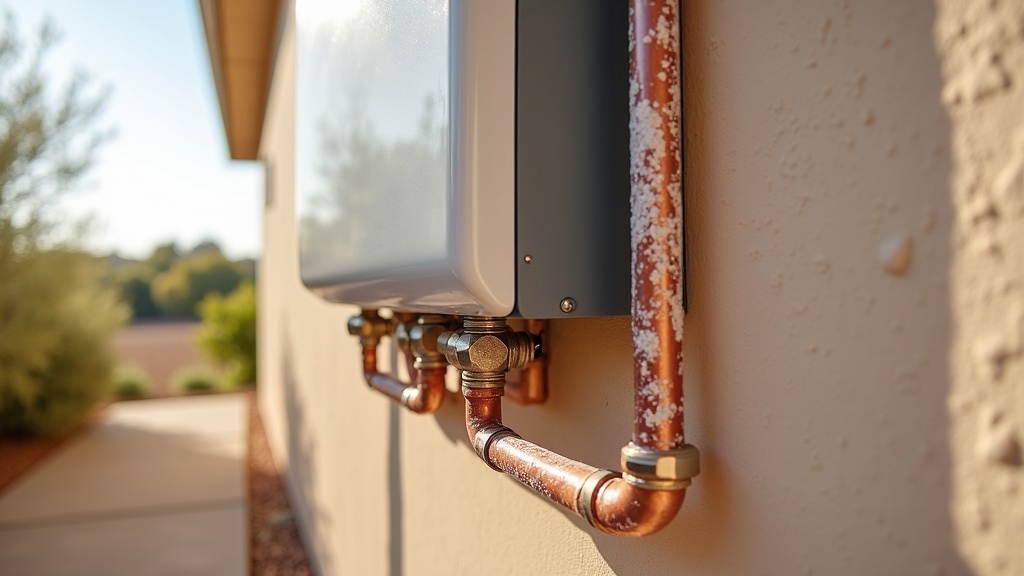
If you have a tankless water heater in Boise, Meridian, Eagle, Nampa, or anywhere else in the Treasure Valley, the mineral content of your local water is quietly working against you. Boise's Drought Emergency Ordinance, adopted July 2026, confirms that public water demand nearly triples during peak summer months. Drought shrinks total water volume while dissolved calcium and magnesium stay constant, concentrating mineral levels above the Treasure Valley's already high baseline of 10 to 17 grains per gallon. Summer is when your tankless unit runs hardest, and it is also when the water hitting your heat exchanger is at its most mineral-laden. That combination accelerates scale buildup faster than most homeowners realize.
Why Tankless Water Heaters and Treasure Valley Water Are a Risky Combination
Boise's municipal water typically runs between 10 and 15 grains per gallon (gpg). Meridian sits even higher, commonly reaching 12 to 17 gpg. Both figures sit well above the 7 gpg threshold where most major tankless manufacturers, including Rinnai, Navien, Noritz, and Rheem, begin voiding warranty coverage if a water softener is not installed. For water quality context in Idaho, the Idaho Department of Environmental Quality publishes regional water quality data updated annually.
Traditional tank-style water heaters have one accidental advantage: sediment settles to the bottom of the tank before it ever reaches the heating elements. It is not a solution, but it is a buffer. Tankless units have no such buffer. Water flows directly through a tightly coiled heat exchanger, and minerals deposit immediately on the hottest surfaces in the system. The narrower the passage, the faster it clogs, and heat exchanger passages are intentionally narrow to maximize heat transfer efficiency.
At Treasure Valley hardness levels, visible scale buildup typically begins within 12 to 18 months of installation. Most homeowners do not notice until the unit starts throwing error codes or producing inconsistent temperatures, which is usually well into the damage cycle. For more on how hard water affects water heaters broadly, see our overview at TrueWater: Hard Water Scale and Water Heaters.
The Summer Drought Factor: When Hard Water Gets Even Harder
As snowpack runoff slows and surface water levels drop, the same mineral load that was spread through a larger water volume in spring becomes concentrated in a smaller one. That means the water coming out of your tap in July and August may be measurably harder than what your water test showed in March.
At the same time, tankless water heaters are running at their highest sustained output of the year. Families are showering after outdoor activity, running irrigation, filling pools, and entertaining. More runtime on harder water means faster scale accumulation, and the hottest months push these units to maximum output at precisely the moment when incoming water mineral concentration is peaking.
The result is a compounding problem: your unit works harder, the water is harder, and scale deposits form faster than at any other point in the calendar year. By the time fall arrives, your heat exchanger has absorbed the heaviest mineral load it will see all year.
What Hard Water Actually Does to a Tankless Water Heater
Scale is not just a cosmetic issue. Each quarter inch of mineral buildup forces the unit to work significantly harder to heat the same volume of water, with efficiency dropping roughly 10 to 15 percent per quarter inch of accumulation. That means higher gas or electric bills and more wear on components that were not designed to operate under that kind of thermal load.
Flow sensors are among the first components to fail. When calcium and magnesium deposits coat a flow sensor, the unit struggles to accurately read water movement. This triggers error codes that often look like flame-failure or low-flow warnings on Rinnai, Navien, and Noritz units. Inlet filters pack with calcium debris, restricting incoming water flow and causing the unit to ignite but deliver only lukewarm water because the flow rate is too low to sustain full heating.
In severe cases, the thermal stress caused by scale buildup causes heat exchanger tubes to crack. At that point, you are looking at a repair cost of $800 to $1,500 in parts alone, not counting labor. Without any intervention, a tankless unit in Meridian or Nampa running on untreated city water can reach unrecoverable heat exchanger damage in as little as 3 to 5 years. A unit that should last 15 to 20 years becomes a 5-year appliance.
Warning Signs Your Tankless Unit Is Already Losing to Hard Water
Most of these symptoms develop gradually, which is part of why homeowners miss them until the damage is already significant. Here is what to watch for:
- Temperature fluctuates during a single shower. The "cold sandwich" effect, where hot water briefly cuts out mid-shower, becomes more frequent as flow sensors and inlet filters degrade.
- The unit takes noticeably longer to reach hot temperature than it did at installation.
- Error codes appear on the unit's display, particularly low-flow or flame-failure codes. These are common early indicators on Rinnai, Navien, and Noritz units operating in high-hardness conditions.
- White powder or mineral flaking appears near the unit's water connections or on the valve housings.
- Hot water pressure drops at fixtures furthest from the unit, often starting with the farthest bathroom or an outdoor fixture.
- Popping or rumbling sounds during operation indicate scale cracking and shifting under thermal stress, a sign that buildup has reached the heat exchanger itself.
How Often Treasure Valley Homeowners Should Descale a Tankless Water Heater
The national standard recommendation for tankless water heater descaling is once per year. In the Treasure Valley, that schedule is not enough. At 10 to 17 gpg, we recommend descaling every six months if you do not have a water softener installed.
A standard descaling flush involves circulating a white vinegar or citric acid solution through the heat exchanger loop for 45 to 60 minutes using a submersible pump and a flush kit. Professional descaling in the Boise area typically runs $150 to $300 depending on the unit's accessibility and severity of existing buildup.
Skipping two consecutive descaling cycles at Meridian or Nampa hardness levels is when the risk of permanent heat exchanger damage climbs sharply. Descaling does not reverse damage that has already occurred. It only prevents further accumulation. By the time a unit is throwing error codes regularly, you may already be past the point where descaling alone can restore full performance.
Tank vs. Tankless in Idaho Hard Water: Which Holds Up Better?
Tank-style heaters have one practical advantage in hard water conditions: sediment accumulates at the bottom of the tank, which delays direct heat exchanger exposure. That delay does not prevent damage, but it does buy time.
Tankless units deliver up to 34 percent better energy efficiency in lower-use households, never run out of hot water, and last significantly longer when properly maintained. In cities like Nampa and Caldwell, where hardness commonly exceeds 14 gpg, a tankless unit operating without a water softener is a poor long-term investment. The EPA's drinking water guidance notes that water hardness is not a health hazard, but its effects on appliances are significant and well-documented.
Tankless is the better appliance, but only when paired with a water softener from day one. A properly sized softener adds $2,500 to $4,500 installed, but it extends your tankless unit's lifespan from the at-risk 3 to 5 year range back to the expected 15 to 20 year range. That math is not close. For more, see our Boise Water Quality Report.
What Boise, Meridian, Eagle, and Nampa Homeowners Should Do Right Now
If you have a tankless unit and no softener, get a free water test this week. Hardness above 10 gpg means the clock is already running on your heat exchanger, and most Treasure Valley households are already above that number.
If your unit is two or more years old without a professional descaling, schedule a flush before fall. Summer operation leaves the heaviest mineral deposit of the year on your heat exchanger. Catching it now, before winter heating demand begins, is the smart window.
If your unit is throwing error codes, do not ignore them. Replacing a flow sensor before the heat exchanger is compromised costs a fraction of what a cracked exchanger repair runs.
If you are planning to purchase a tankless unit, budget for the softener as part of the installation cost, not as a future upgrade. Any scale that forms in the interim stays in those passages permanently.
Eagle and Star homeowners on private wells face a compounding risk that city water customers do not. Well water hardness is not regulated and varies seasonally as aquifer draw-down during drought concentrates minerals further. Your baseline hardness reading in August may be significantly higher than what a spring test showed.
The Fix That Makes Tankless Water Heaters Work in Idaho Hard Water
A properly sized salt-based water softener brings incoming water hardness to 0 to 1 gpg before it reaches your tankless unit's heat exchanger. At that hardness level, scale formation stops entirely. The heat exchanger stays clean, flow sensors read accurately, and the unit operates at the efficiency level it was engineered to deliver.
Most major tankless manufacturers publish explicit warranty language requiring softened water above 7 gpg. Rinnai, Navien, Noritz, and Rheem all include this provision, and all of them have grounds to deny warranty claims on scale damage when no softener is documented.
Salt-free water conditioners are marketed as an alternative. At 10 to 17 gpg, however, salt-free systems reduce scale adhesion but do not eliminate mineral formation in narrow heat exchanger passages. Ion exchange, the process that drives salt-based softeners, is the only method that reliably removes dissolved calcium and magnesium before they reach your unit.
The math is straightforward. A softener installed today runs $2,500 to $4,500 depending on sizing and your home's water demand. A heat exchanger repair after scale damage runs $800 to $1,500 in parts before labor, and that assumes the unit is still salvageable. Protecting the investment you already have costs less than repairing the damage that comes without protection.
TrueWater offers free water testing across the Treasure Valley, including Boise, Meridian, Eagle, Nampa, Caldwell, Kuna, and Star. Call us at (208) 968-2771 and we will tell you exactly what your hardness reading is, what it means for your tankless unit's current condition, and what a properly sized solution looks like for your household. No pressure, just data.