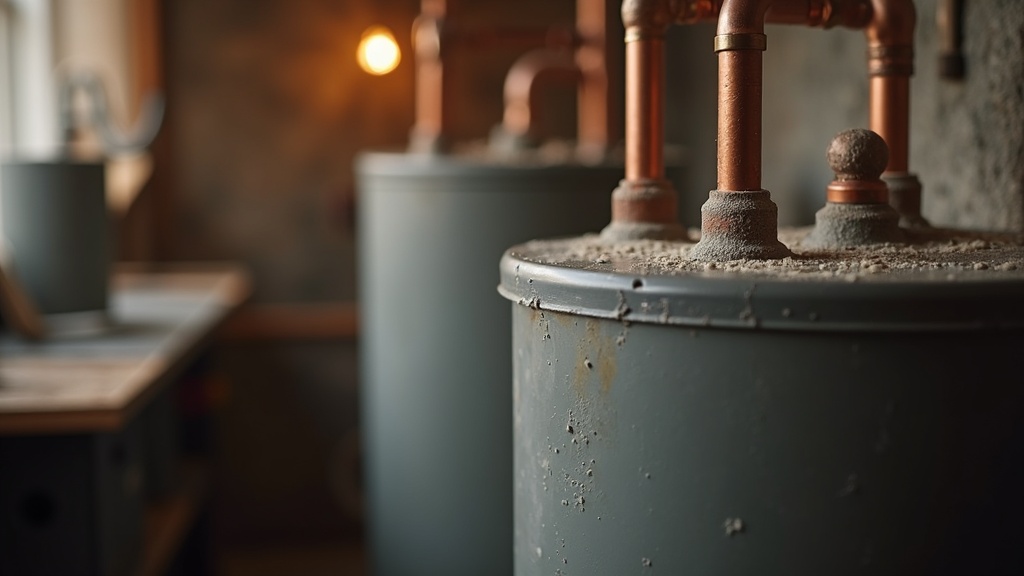
Your water heater is probably the most expensive appliance in your home that you never think about. And in the Treasure Valley, hard water is quietly costing you hundreds of dollars every year through a process most homeowners never see until it is too late.
What Scale Actually Is (And Why It Forms Here)
When water from the Boise Aquifer or Treasure Valley municipal supplies passes through your water heater, it carries dissolved calcium and magnesium minerals. Boise homes typically see 10 to 13 grains per gallon (gpg) of hardness. Meridian pushes even higher, often 12 to 17 gpg depending on your neighborhood and the season.
The moment that mineral-laden water heats up, something predictable happens: the minerals drop out of solution and bond to whatever surface they contact. Inside your water heater, that surface is the tank walls and the heating element. Over months and years, those microscopic deposits accumulate into what we call scale. It looks like white, chalky rock. And it behaves like an insulating layer between your heating element and the water you are paying to heat.
This is not a rare or unusual problem. Every home in the Treasure Valley with untreated water is experiencing it right now. The only question is how much scale has built up and how much it is already costing you.
The Numbers: What Scale Costs Treasure Valley Homeowners
The U.S. Department of Energy has studied this in detail. Their findings are stark. For every quarter inch of scale buildup, water heater efficiency drops by 10 to 15 percent. In practical terms, that means:
- A water heater that cost $600 per year to operate now costs $660 to $690 after two years without treatment
- After five years, that same heater may be spending $750 to $800 per year doing the same job it once did for $600
- At the 10-year mark, if the heater has not already failed early, you may be spending 30 to 40 percent more on hot water than you need to
Across the Treasure Valley, where natural gas and electricity costs have risen steadily alongside the regional population boom, those extra costs add up fast. A family that has been in a Meridian home for 8 years without water treatment has almost certainly paid more than $1,000 in unnecessary energy costs from scale alone. And that number does not include the cost of early appliance replacement.
Early Replacement: The Bigger Hit to Your Budget
A standard tank water heater in a Treasure Valley home should last 10 to 12 years with normal maintenance. In high-hardness areas without water treatment, we routinely see them fail at 6 to 8 years. Sometimes sooner.
When scale builds up to the point where the heating element is buried in mineral deposits, the element overheats trying to push heat through the insulating layer. Eventually it burns out. In gas heaters, scale on the tank floor traps sediment that creates hot spots, thinning the tank wall from inside and eventually causing leaks.
A mid-grade 50-gallon water heater runs $600 to $900 for the unit alone. Installation in the Treasure Valley typically adds another $400 to $700 depending on access and any code upgrades required. You are looking at $1,000 to $1,600 for a replacement you might have avoided entirely. If you are replacing your water heater two years early every cycle, that is $1,000 to $1,600 every decade just from hard water damage.
We have talked to homeowners in the Bainbridge and Paramount subdivisions in Meridian who have replaced water heaters twice in 15 years. Both times, their plumber told them the tank was full of scale. Neither time did the plumber mention that a water softener would likely prevent it from happening again.
The Local News Angle: Why This Is Getting Worse
Here is the context that makes this particularly relevant right now. Idaho is experiencing one of its most significant drought years on record in 2026. Snowpack in the Boise Basin is at roughly one-third of normal levels. That matters for your water heater because when surface water supplies run low, municipalities draw more heavily from groundwater.
Treasure Valley groundwater comes from the Boise Aquifer, which sits in volcanic basalt geology loaded with calcium and magnesium. The deeper and longer water sits in that geology, the harder it becomes. During drought years, when the aquifer is being drawn down faster and surface water blending is reduced, mineral concentrations in tap water tend to increase.
In plain terms: your water may be harder right now than it was two years ago, and harder water accelerates scale formation in your water heater. The timing is not great for anyone who has been putting off a water quality conversation.
Tankless Heaters Are Not Immune
A lot of homeowners assume that switching to a tankless or on-demand water heater solves the scale problem. It does not. Tankless heaters have a heat exchanger, a compact coil of metal tubing through which water is rapidly heated. That coil is extremely vulnerable to scale formation.
Scale in a tankless heat exchanger does not just reduce efficiency. It can clog flow sensors, cause the unit to fault and shut off, and in extreme cases crack the heat exchanger itself, resulting in a $800 to $1,500 repair or full replacement. Most major tankless manufacturers void the warranty if the unit is operated in water conditions above 7 gpg without a water softener. In Meridian, that means your warranty may already be void if you have untreated water.
We are not saying do not get a tankless heater. Tankless systems are excellent technology and we install them regularly. We are saying that any tankless heater in the Treasure Valley should be paired with a water softener as a matter of basic protection.
What You Can Do About It
The most effective long-term solution is a whole-house water softener installed at the point of entry. By removing calcium and magnesium before the water reaches your heater (or any other appliance), you eliminate the raw material that scale is made of. The water heater does its job, runs at full efficiency, and lasts its full designed lifespan.
A quality water softener system for a Treasure Valley home typically runs $2,500 to $4,500 installed, depending on home size and water hardness level. Spread over 10 years, that is $250 to $450 per year. When you account for water heater energy savings, extended appliance life, reduced cleaning products, and better performance from your dishwasher and washing machine, most families see a net positive within three to five years.
Short of a softener, there are interim steps worth knowing about. Annual water heater flushing removes sediment and slows scale accumulation, though it does not stop it. Tankless owners with descaling ports can run a vinegar flush annually. A whole-house sediment filter is not a solution but can reduce the load on your water heater slightly.
If your water heater is already several years old and showing signs of scale buildup (the sounds, the efficiency drop, lukewarm water during heavy use), the smart sequence is to schedule a free water test first, understand your actual hardness level, and then make a decision about treatment before the heater fails and you are making an emergency replacement decision under pressure.
For more on how hard water affects your other home systems, see our article on 5 signs your home needs a water softener and our 2026 Idaho water softener cost guide.
Frequently Asked Questions
Find Out What Hard Water Is Costing Your Home
Our free water test takes 30 minutes and tells you exactly what is in your water and what it is doing to your appliances. No pressure, no obligation.