If you live in Boise, Meridian, Eagle, or Nampa, your tap water is some of the hardest in the Pacific Northwest. Boise municipal water typically runs between 10 and 15 grains per gallon (gpg). Meridian is harder still, commonly landing between 12 and 17 gpg. That is two to three times the level at which water hardness starts doing real damage to your pipes, water heater, and appliances.
The 2026 Idaho drought emergency, which Governor Brad Little declared across all 44 counties after the warmest winter and lowest snowpack ever recorded, has put water supply front of mind for a lot of Treasure Valley households. But drought conditions and mineral hardness are separate issues. Even if Boise lifts its Stage 2 conservation restrictions tomorrow, the Snake River Plain aquifer will still push calcium and magnesium-laden water through your pipes. That is a permanent feature of living here.
This guide explains exactly how a water softener works, why Treasure Valley homes need one more than most, and how to pick the right system for your house. No jargon, no sales pressure. Just the plain-language version.
What Makes Treasure Valley Water So Hard?
Hard water simply means water that carries dissolved calcium and magnesium. The higher the concentration, the harder the water. Hardness is measured in grains per gallon (gpg) or parts per million (ppm). Anything above 7 gpg is considered hard; above 10.5 gpg is very hard.
The Treasure Valley sits on the Snake River Plain, a volcanic landscape underlain by basalt aquifers. As groundwater moves through that basalt and the calcium-rich sediments on top of it, it dissolves minerals along the way. By the time that water reaches your meter, it is carrying a significant mineral load. Boise runs 10-15 gpg. Meridian, which draws more heavily from groundwater, runs 12-17 gpg. Eagle and Nampa are in a similar range.
You have probably already seen the signs: white crusty buildup around faucets and showerheads, a film on freshly washed glasses, laundry that feels stiff even after fabric softener, or soap that refuses to lather properly. All of that is calcium and magnesium leaving deposits wherever water evaporates.
For more on how the Treasure Valley's hardness numbers compare to national averages, see our article on the water hardness scale in gpg for the Treasure Valley.
The Core Problem Hard Water Causes at Home
Scale is the most expensive side effect of hard water. When hard water heats up, calcium and magnesium precipitate out and cling to surfaces. Inside a water heater, that means a thickening layer of mineral deposits on the heating element. The U.S. Department of Energy has documented that scale reduces water heater efficiency by roughly 1-2% per grain of hardness over time. At Meridian's 15 gpg, an untreated heater can lose 15-25% of its efficiency within a few years.
The same buildup narrows supply pipes gradually. Older homes in Boise and Meridian with original galvanized plumbing can develop significantly reduced flow from years of scale accumulation. Dishwashers, washing machines, and ice makers all experience shortened lifespans when hard water runs through them continuously.
Hard water also affects you directly. Calcium and magnesium bond with soap, forming a sticky residue that coats skin and hair rather than rinsing cleanly. Many people with dry or irritated skin in the Treasure Valley see noticeable improvement after installing a softener.
On the household budget side, studies on hard water costs consistently put the extra expense of untreated hard water at $400 to $600 per year for a typical family, factoring in higher soap consumption, more frequent appliance repair, and reduced water heater efficiency.
What a Water Softener Actually Does
A water softener does one thing: it swaps calcium and magnesium ions in your water for sodium ions. The water that comes out the other side no longer carries the minerals that cause scale.
It is worth being clear about what a softener does not do. It is not a water filter. It does not remove bacteria, viruses, nitrates, chlorine, or emerging contaminants like PFAS. If you have concerns about those issues, a softener should be paired with a separate filtration system. For a detailed comparison of softening versus conditioning technologies, see our guide on water softener vs. conditioner for the Treasure Valley.
What you will notice after installation: water that feels slicker (that is the absence of minerals, not an additive), dishes that come out of the dishwasher without spots, showerheads and faucets that stay clean, and laundry that feels softer. The white crust stops building immediately.
Inside the Tank: How Ion Exchange Works Step by Step
The core of every salt-based water softener is a mineral tank filled with thousands of tiny resin beads, each about the size of a grain of sand. These beads are made of a cross-linked polystyrene polymer and carry a negative electrical charge. Sodium ions, which are positively charged, cling to those beads during the initial setup phase.
Here is what happens every time water flows through the tank:
- Hard water enters from the top of the mineral tank. It begins flowing down through the bed of resin beads.
- Calcium (Ca2+) and magnesium (Mg2+) ions are attracted to the negatively charged beads. Because calcium and magnesium carry a stronger positive charge than sodium, they displace the sodium ions and bond tightly to the resin.
- Sodium ions are released into the water in exchange, one sodium ion for each calcium or magnesium ion captured. The water now carries sodium instead of hardness minerals.
- Softened water exits through the bottom of the tank and flows into your household plumbing.
Think of the resin bed like a crowded parking lot where sodium cars are parked in every spot. When calcium and magnesium pull in, they are bigger vehicles that take the spots and push the sodium cars out onto the road. The sodium leaves in the water; the calcium and magnesium stay parked on the resin.
The USGS Water Science School has additional background on the chemistry of hard water and ion exchange if you want to go deeper. Quality resin beads last 10 to 15 years under normal residential use before they need replacement.
The Regeneration Cycle: How the System Recharges
After processing a few thousand gallons, the resin beads fill up with calcium and magnesium and lose their ability to soften water. At that point, the system needs to flush those minerals out and recharge the beads with fresh sodium. That process is called regeneration.
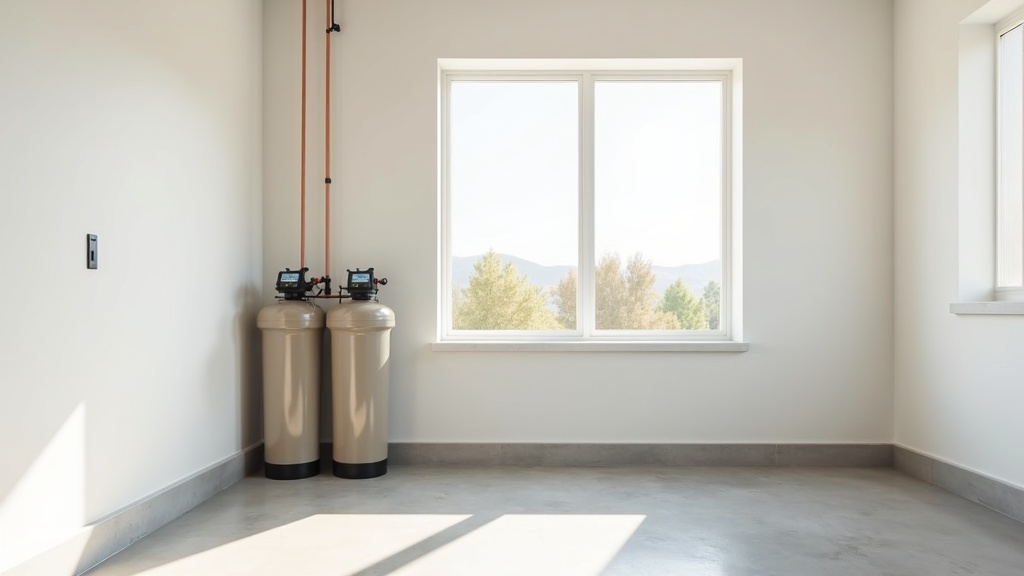
The second tank in a softener system, the brine tank, holds a concentrated saltwater solution. During regeneration, that brine is drawn through the resin bed. The high sodium concentration in the brine overwhelms the calcium and magnesium on the beads, displacing them and flushing them out to drain. The beads are left recharged with sodium, ready for another softening cycle.
Regeneration happens in four phases:
- Backwash: Water flows upward through the resin tank to loosen and flush out any sediment or debris.
- Brine draw: The concentrated salt solution is slowly drawn through the resin bed, recharging the beads.
- Slow rinse: Fresh water rinses residual brine from the resin at a slow flow rate.
- Fast rinse: A final fast rinse packs the resin bed and clears any remaining brine before the system returns to service.
Most modern softeners regenerate on demand, meaning the system monitors your actual water usage and only regenerates when the resin capacity is genuinely exhausted. Older timer-based units regenerate on a fixed schedule regardless of need, which wastes both salt and water. At Boise's Stage 2 drought conservation level, a demand-initiated system is the more responsible choice.
For a typical Treasure Valley family of four, regeneration happens roughly every three to seven days. Your main ongoing task is keeping the brine tank stocked with salt, which works out to about one 40-pound bag per month.
Choosing the Right System for Your Treasure Valley Home
Softeners are sized by grain capacity, which is the total amount of hardness minerals the resin can remove before regeneration is needed. Common residential sizes are 32,000 grains (32K), 48,000 grains (48K), and 64,000 grains (64K). Picking the right size matters. Too small and the system regenerates constantly, wasting salt and water. Too large and the resin sits idle long enough to develop bacterial growth between cycles.
Here is the sizing formula: multiply the number of people in your household by their estimated daily water use (75 gallons per person per day is a reliable average) by your water hardness in gpg. That gives you daily grain removal. Multiply by 7 to get weekly capacity needed.
Sizing Example: Meridian family of 4, water hardness 15 gpg
4 people × 75 gallons × 15 gpg = 4,500 grains per day
4,500 × 7 days = 31,500 grains per week
Recommendation: 48K system (leaves a comfortable buffer without over-sizing)
On the salt-based versus salt-free question: at 12-17 gpg, salt-free conditioners are not a reliable solution. Salt-free systems work by changing the structure of calcium crystals so they do not stick as easily, but they do not actually remove hardness minerals from the water. At Treasure Valley hardness levels, a true ion exchange salt-based softener is what we recommend.
If you are in Star, Kuna, rural Nampa, or on a private well, you may also have dissolved iron in your water. Iron clogs resin beads and shortens the life of a softener significantly. We often recommend pairing a softener with a dedicated iron filter in those areas. If you are unsure whether iron is present, a water test will tell you before you invest in equipment.
Frequently Asked Questions
Get Your Treasure Valley Water Tested, Free
We offer free water testing for homeowners in Boise, Meridian, Eagle, Nampa, Star, and Kuna. The test takes about 20 minutes, there is no obligation, and you walk away knowing exactly what is in your water. We test for hardness in grains per gallon, iron content, pH, and total dissolved solids (TDS). If your water needs a solution, we will tell you what it is and why. If it does not, we will tell you that too.