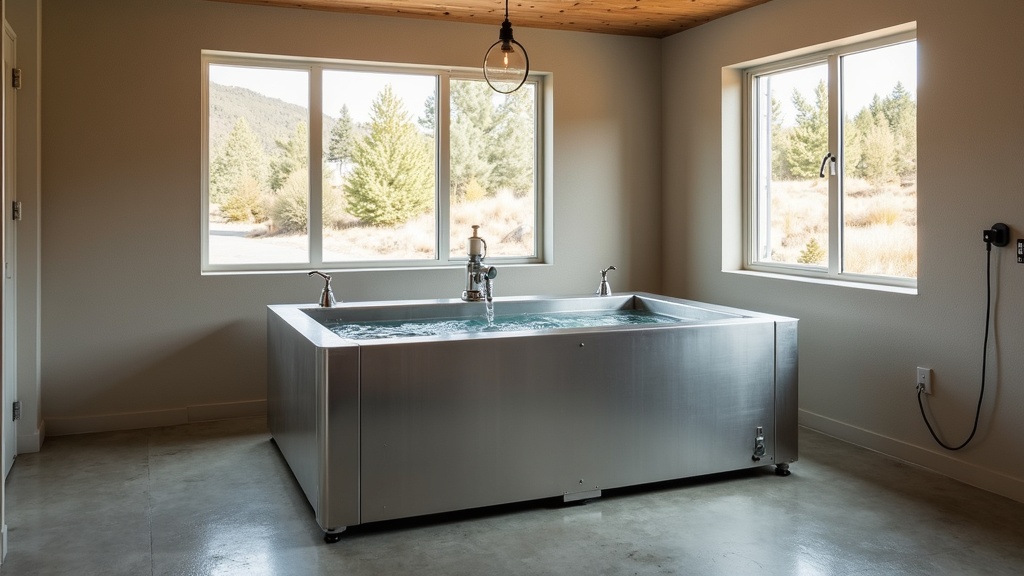
Cold Plunge at Home: What Boise Water Does to Yours
July 9, 2026 • TrueWater Idaho
Why Everyone in the Treasure Valley Seems to Be Cold Plunging Right Now
If your social feed looks anything like most people's in Boise and Meridian this summer, it's full of chest freezers converted into cold plunge setups, stock tanks on backyard patios, and the occasional person dropping into a $2,500 dedicated tub with a serene expression. Cold plunging has moved from niche biohacker territory into full-on Treasure Valley backyard culture, and it's easy to see why.
The appeal is real. After a trail run at Table Rock, a long bike ride through the foothills, or just surviving a 100-degree Meridian afternoon, dropping into 50-degree water for a few minutes genuinely works. There is solid research published through the NIH showing cold water immersion reduces muscle soreness and supports recovery. The active lifestyle crowd here has picked up on it fast, and the DIY builds on TikTok have made it feel accessible at almost any budget.
People are building setups for $150 with a stock tank and ice. Others are spending $400 to $600 on a chest freezer conversion with a circulation pump. And plenty of Treasure Valley homeowners are going all-in on dedicated cold plunge tubs in the $1,500 to $3,000 range. Whatever the setup, the culture is here and it is not slowing down.
Setting Up Your Home Cold Plunge: The Real Costs and What to Expect
If you're planning your own setup, here's what actually matters. The target temperature range for most cold plunge protocols is 50 to 59 degrees Fahrenheit. Idaho tap water comes out cold enough to get you started, but holding that temperature reliably is where the equipment choices matter.
Your main options:
- Stock tank with ice: The cheapest entry point. You fill it, add ice from the store, plunge, drain. No moving parts, no maintenance. Works, but ongoing ice costs climb fast through July and August.
- Chest freezer DIY build: The TikTok classic. You convert a used deep chest freezer, add a submersible pump for circulation, and sometimes a UV filter. Gets cold fast, holds temperature well, and the ongoing cost is mostly electricity.
- Chiller attachment on a tank or tub: Dedicated chiller units connect inline and cycle water through a cooling coil. More consistent than ice, more flexible than a chest freezer, and easier to dial in a specific temperature.
- Dedicated cold plunge tub: Turnkey, typically includes filtration, precise temperature control, and a cleaner finish. Built to run daily with minimal fuss, assuming the water cooperates.
Most setup guides cover the equipment choices, protocol timing, and temperature targets in detail. What almost none of them mention is the one variable that determines whether your setup runs clean for years or becomes a maintenance headache by next spring. That variable is your water.
The Hidden Variable That Determines How Long Your Setup Lasts
Here's what happens inside a cold plunge system running on Boise or Meridian tap water. The calcium and magnesium minerals in hard water don't evaporate when water cools or circulates. They deposit on every surface they touch.
On chiller coils, that mineral scale acts as insulation. The coils can't transfer heat as efficiently, so the unit runs longer and works harder to hit your target temperature. Over weeks and months, you're paying more in electricity and putting more wear on the compressor. It's the exact same mechanism that shortens the life of your dishwasher heating element and your water heater. The hard water appliance damage breakdown covers that in detail if you want the full picture.
On pump filters, scale clogs the mesh and restricts flow. You end up cleaning or replacing filters more often than the manufacturer intended. On tub walls and liner surfaces, you get that familiar white crust that takes real effort to scrub off and comes right back after the next fill. In a chest freezer build with a liner, the buildup around the waterline looks bad and is a consistent maintenance chore.
None of this destroys your setup overnight. But it shortens the lifespan of every component, increases how much time you spend maintaining instead of plunging, and costs you real money over a season or two.
How Hard Is Boise and Meridian Water, Really?
The Treasure Valley draws from a mix of surface water and groundwater sources. Depending on your neighborhood and the time of year, Boise water hardness typically runs 8 to 13 grains per gallon (GPG). Meridian water comes in up to 143 ppm, which is roughly 8.4 GPG. For context, water above 7 GPG is classified as hard. Boise and Meridian are both comfortably in that territory. The full numbers are in the 2026 Boise water quality report and the Meridian water hardness breakdown.
This summer, those numbers may be running higher than typical. The 2026 drought has pushed the City of Boise to activate conservation ordinances and draw more heavily from deeper groundwater reserves. Deeper groundwater means more contact with mineral-rich rock formations underground, which means more hardness coming out of your tap. If your cold plunge water looked clearer last summer and you're seeing more scale or cloudiness this year, the drought is a likely factor.
That's not a reason to panic about your water. It's just worth knowing that this particular summer is pushing Treasure Valley water toward the harder end of the range.
What Soft Water Actually Does for Your Cold Plunge (and Everything Else)
Run your cold plunge on softened water and the practical differences show up quickly. Chiller coils stay clean, so the unit maintains the efficiency it was designed for. Pump filters last longer between cleanings. Tub walls stay clear. The water itself looks better and stays cleaner longer between refills, which means fewer drain-and-refill cycles over the summer.
The plunge experience doesn't change. Soft water is cold. You still get the same recovery benefit. What changes is the maintenance side. You stop spending weekend time fighting scale buildup and start just using the setup you put money into.
And because a water softener treats all the water entering your home, the benefit extends to every appliance, every shower, every faucet. It's not a cold plunge accessory. It's a whole-home upgrade that happens to solve the cold plunge problem along with everything else. TrueWater Idaho serves homeowners across the full Treasure Valley, from Boise and Meridian to Eagle, Nampa, and Kuna.
Frequently Asked Questions About Cold Plunges and Water Quality
Can I use filtered water in my cold plunge instead of softened water?
Standard filtration, including sediment filters, carbon block filters, and UV systems, removes particles and contaminants but does not remove hardness minerals. To prevent scale buildup, you need ion exchange softening, which is exactly what a water softener does. A reverse osmosis system will remove hardness minerals, but it produces water slowly and isn't practical for filling a full tub. A point-of-entry water softener is the efficient solution for cold plunge setups and whole-home protection.
How often should I drain and refill my cold plunge with Boise tap water?
With hard water and regular daily use, most people in the Boise area find they need a full drain and refill every two to four weeks to keep the water clear and the equipment performing well. With softened water in the line, many cold plunge owners extend that to six to eight weeks or longer. The bigger difference is between drain cycles: with hard water, you're also spending time scrubbing scale off walls and clearing clogged pump filters. Soft water cuts that maintenance work significantly.
Will soft water change how the cold plunge feels on my skin?
Soft water feels slightly silkier on skin compared to hard water. In a shower you notice it right away. In a cold plunge where you're typically in for two to ten minutes, the tactile difference is subtle. The temperature and the physiological response are unchanged. What some people do notice is that their skin feels less tight and dry coming out, because hard water leaves a mineral film on skin that soft water doesn't.
How can I tell if my chiller is already scaling up from hard water?
A few signs to watch for: the chiller runs longer than it used to in order to reach your target temperature. You hear it cycling on and off more frequently. White deposits appear around the water inlet or outlet on the chiller housing. The water looks slightly cloudy even right after a fresh fill. Any of these suggests scale is accumulating. Switching to softened water at that point slows further buildup. If scale is already heavy, a diluted citric acid flush through the system can clear existing deposits before the softener maintains it going forward.
Find Out Exactly How Hard Your Water Is
TrueWater Idaho offers free water tests for homeowners across Boise, Meridian, Eagle, Nampa, and the full Treasure Valley. You get the actual hardness numbers for your specific address, not a generic range. If hard water is the issue, we'll show you what a solution would look like for your home and your budget. No pressure. Just the data you need to make a smart decision about your setup.
Call (208) 968-2771 for Your Free Water TestServing Boise, Meridian, Eagle, Nampa, Kuna, and surrounding Treasure Valley communities.