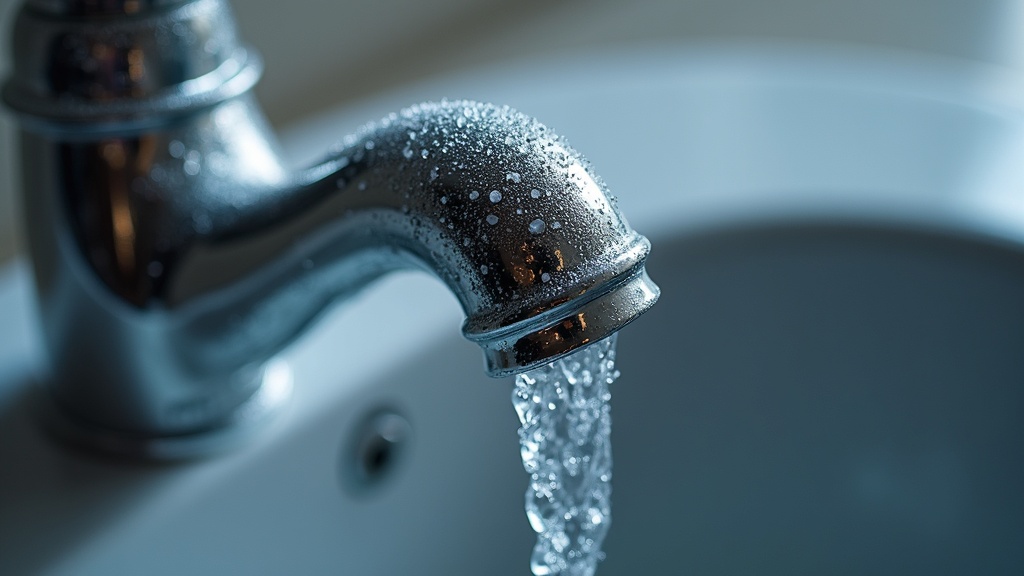
You scrub it off on a Tuesday. By Friday it is back. That chalky white crust around your faucet base, caked into your showerhead, crusted over the aerator screen on your kitchen sink. If you live in Boise, Meridian, Eagle, or anywhere across the Treasure Valley, you know exactly what we are talking about. It is limescale, and it is the visible evidence of one of the hardest municipal water supplies in the Pacific Northwest.
We test water all over the Treasure Valley every week. Boise typically comes in between 10 and 15 grains per gallon (gpg). Meridian pushes higher, running 12 to 17 gpg in many neighborhoods. For context, the U.S. Environmental Protection Agency defines water above 7 gpg as hard and water above 10.5 gpg as very hard. Most homes we visit in the Treasure Valley fall squarely in the very hard category. That white buildup on your faucets is not a cleaning problem. It is a water problem.
What Is That White Crust, Exactly?
Limescale is calcium carbonate and magnesium carbonate in solid form. Both minerals dissolve naturally into groundwater as it moves through the limestone and basalt geology underlying the Snake River Plain and the broader Treasure Valley basin. When that mineral-rich water reaches your faucet, some of it evaporates. The water molecules leave, but the calcium and magnesium stay behind. Over days and weeks they crystallize into the hard, chalky layer you are always scrubbing at.
The same process happens everywhere water sits or flows and then dries: around the base of faucets, inside showerhead nozzles, on the heating element of your dishwasher, on the inside walls of your water heater, and inside every supply pipe in your home. You only see the deposits on exposed surfaces. The ones forming inside your plumbing are invisible until something breaks.
Scale formation starts at around 7 gpg. At Boise levels of 10 to 15 gpg, buildup is steady and consistent. At Meridian levels reaching 17 gpg, the rate of accumulation is noticeably faster. Newer residents who moved here from softer-water cities in the Pacific Northwest or the Midwest are often surprised by how quickly their fixtures go from clean to coated.
Boise Water in 2026: Why This Problem Is Not Going Away
Boise City and its surrounding utilities draw from a combination of surface water from the Boise River and groundwater from the Snake River Plain Aquifer. Both sources carry the mineral signature of the region's volcanic and sedimentary geology. The Idaho Department of Water Resources continues to study and model groundwater flow across the Treasure Valley through its ongoing Treasure Valley Groundwater Flow Model project, and nothing in that research suggests the underlying hardness will change.
Recent monitoring from Idaho DEQ identified new nitrate concerns near Star, Idaho, and Gowen Field in Boise is under continued PFAS monitoring. While those are separate issues from hardness, they reflect a broader reality: Treasure Valley water infrastructure is under scrutiny, and homeowners are paying closer attention to what is actually in their water. Limescale is the part of the story you can see every time you walk into your bathroom. The mineral load causing it is present in every glass of water you pour and every load of laundry you run.
What Limescale Does to Your Plumbing and Appliances
The cosmetic annoyance is the least of the problem. Here is what limescale actually costs Treasure Valley homeowners over time.
Reduced Water Flow
Scale builds up inside supply lines and fixture aerators over years, narrowing the passage water flows through. Research shows scale can reduce pipe flow by 40% or more in severely affected lines. The first signs are usually weak pressure at specific faucets or a showerhead that sprays unevenly. By the time flow is noticeably reduced, the buildup inside is already significant.
Showerhead Clogging
A study by the Battelle Memorial Institute found that more than 75% of showerhead nozzles became clogged within just one week of exposure to hard water. In a Meridian home running 15 gpg or higher, that is not a hypothetical. That is what happens every time you run the shower.
Water Heater Damage
This is where the real money goes. The Water Quality Research Foundation found that up to 30 pounds of calcium carbonate can accumulate inside a water heater over its lifetime. That scale layer insulates the heating element from the water it is supposed to heat, forcing the unit to run longer and hotter to reach your set temperature. The same research found energy consumption can increase by up to 48% in heavily scaled heaters. The U.S. Department of Energy has documented that limescale buildup can cut a water heater's lifespan by 25 to 40%. On a $1,200 to $2,000 tank, that is real money.
We often find scale deposits of a quarter inch or more inside water heaters in homes that have never had a softener. In Meridian homes with 15 to 17 gpg water and no treatment, the damage accumulates faster than most homeowners realize.
Appliance Wear
Dishwashers and washing machines with heating elements suffer the same insulation effect as water heaters. The American Water Works Association has found that hard water can reduce appliance lifespan by up to 30%. For a dishwasher running daily in a Boise home at 12 gpg, that adds up to years of service life lost. You can also see it in the spots and film left on dishes and glasses after every wash cycle, a direct result of the mineral content in your rinse water.
For more on how hard water affects more than just your fixtures, read our article on how Treasure Valley hard water affects your hair and scalp.
The Gap in What Most People Are Told
Most articles about white buildup on faucets stop at cleaning tips. Vinegar soak, baking soda paste, commercial descaler. Those are fine for removing existing deposits, and we will cover them in a moment. But almost no one explains that cleaning removes the symptom, not the cause. The moment fresh hard water touches that clean faucet surface and evaporates, the limescale process starts again. You are on a maintenance treadmill.
The second gap is the hidden damage. Faucet deposits are visible, so homeowners address them. Scale inside water heaters, inside pipes, and on dishwasher elements is invisible until something fails. By the time a water heater element burns out or a pipe pressure-tests low, the scale has been building for years. The white crust on your faucet is a warning signal for everything you cannot see.
Temporary Fixes That Actually Work
If you want to clean existing limescale while you figure out a longer-term solution, these methods work.
- White vinegar soak: Soak a cloth in undiluted white vinegar and wrap it around the affected fixture for 30 to 60 minutes. The acetic acid dissolves calcium carbonate without damaging most finishes. For faucet aerators, unscrew the screen and drop it directly into a small bowl of vinegar.
- Baking soda paste: Mix baking soda with a small amount of water or vinegar to form a paste. Apply it to the buildup, let it sit for 15 minutes, then scrub with a soft brush. Good for heavier deposits where you need mild abrasion.
- Commercial descalers: Products containing citric acid or phosphoric acid work faster on heavy buildup. Follow label instructions carefully and test on a small area first with chrome or brushed nickel finishes.
Expect to repeat any of these monthly or more in Boise and Meridian. That is the reality of 10 to 17 gpg water without treatment.
The Permanent Solution: Treating the Water at Entry
The only way to stop limescale formation entirely is to remove calcium and magnesium from your water before it reaches any fixture in your home. A whole-home ion-exchange water softener does exactly that. As water enters your home, it passes through a resin bed that exchanges calcium and magnesium ions for sodium ions. The result is soft water throughout the entire system: faucets, showers, dishwasher, washing machine, and most importantly, your water heater.
With softened water, no new limescale forms anywhere. Existing deposits in older pipes and appliances gradually dissolve as soft water flows through. Faucets stay clean. Showerheads stay clear. Water heaters run at designed efficiency. Appliances last their full expected lifespan.
The cost of a properly sized whole-home softener for a Treasure Valley home is generally justified by energy savings and appliance protection within a few years. For details on what systems cost and what to look for, our 2026 Idaho water softener cost guide breaks it down clearly by home size and water hardness level.
We serve Boise, Meridian, Eagle, Nampa, Caldwell, Kuna, and Star. Every home we test gets a free water hardness reading before we recommend anything. If your water does not need treatment, we will tell you that too.
Frequently Asked Questions
Ready to End the White Buildup?
Get a free water hardness test from TrueWater Idaho. We serve Boise, Meridian, Eagle, and the entire Treasure Valley.