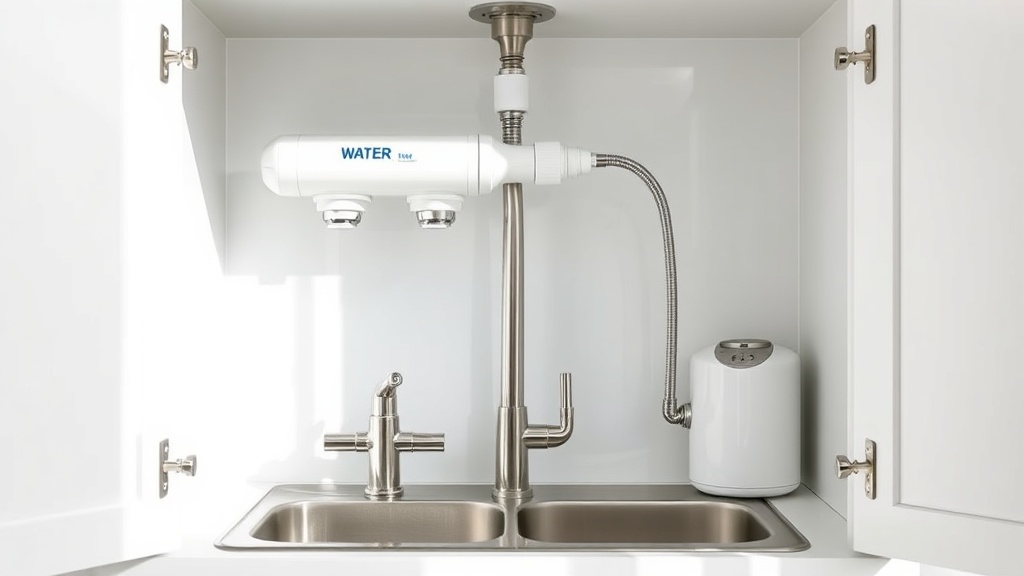
A water softener and a reverse osmosis system solve completely different problems. A softener removes hardness minerals from every tap in your home, protecting your appliances, pipes, skin, and hair. A reverse osmosis (RO) system purifies drinking water at a single tap, removing a much broader range of contaminants down to near-pure water. Most Treasure Valley homeowners benefit from one or the other. Some benefit from both. Here is how to know which situation you are in.
What a Water Softener Does
A whole-house water softener is installed on your cold water main line, before the water heater. Every tap in your home, every appliance, every shower, and every load of laundry runs through it. The system uses a process called ion exchange: water passes through a resin bed loaded with sodium ions. Calcium and magnesium ions (the hardness minerals) swap places with sodium ions and get held in the resin. The water that flows out has the hardness removed.
At Meridian's 8.4 GPG hardness, a properly sized softener takes water that contains roughly 545 milligrams of calcium and magnesium per gallon and reduces it to near-zero hardness. The water feels noticeably different immediately: silky in the shower, no scale on fixtures, soap lathers easily, dishes come out clear.
What a softener does:
- Removes calcium and magnesium (hardness) whole-house
- Eliminates scale buildup on fixtures, pipes, and appliances
- Extends water heater and appliance lifespan
- Improves soap lather and reduces product consumption
- Softens skin and hair feel in the shower
- Protects all plumbing in the home
What a softener does NOT do:
- Does not remove chlorine, chloramines, or disinfection byproducts
- Does not remove nitrates, arsenic, or other chemical contaminants
- Does not remove bacteria, viruses, or pathogens
- Does not improve taste for drinking (adds a small amount of sodium)
- Does not purify water to drinking-water-quality standards beyond what the city already provides
What a Reverse Osmosis System Does
A reverse osmosis system is typically an under-sink unit that treats water at one location, usually the kitchen sink, for drinking and cooking. Water is pushed through a semi-permeable membrane under pressure. The membrane has pores small enough to block dissolved solids, heavy metals, nitrates, chlorine, certain pesticides, and most other contaminants. The result is water that is close to pure H2O.
A standard under-sink RO system in a Meridian or Boise home costs $300 to $600 installed and produces 50 to 75 gallons of purified water per day, stored in a small tank under the sink. It has its own dedicated faucet at the sink. Filter stages (sediment, carbon, RO membrane, post-carbon) need replacing every 6 to 24 months depending on the stage, at a total annual maintenance cost of roughly $50 to $150.
What an RO system does:
- Removes up to 99% of dissolved solids, including hardness minerals
- Removes chlorine, chloramines, and disinfection byproducts
- Removes nitrates (important for well water in rural Idaho)
- Removes heavy metals: lead, arsenic, chromium, fluoride
- Produces near-pure water with a clean, neutral taste
- Protects against a much wider range of contaminants than filtration alone
What an RO system does NOT do:
- Does not treat whole-house water. Only the one tap it is connected to.
- Does not prevent scale on your water heater, dishwasher, or showerheads
- Does not soften water in your pipes, shower, or laundry
- Does not produce water fast enough to supply a whole house (produces gallons per day, not gallons per minute)
Side-by-Side Comparison
| Feature | Water Softener | Reverse Osmosis |
|---|---|---|
| Coverage | Whole house | One tap only |
| Removes hardness | Yes | Yes (at that tap) |
| Protects appliances | Yes | No |
| Removes nitrates | No | Yes |
| Removes chlorine | No | Yes |
| Improves skin & hair | Yes | No |
| Upfront cost (installed) | $2,000 – $3,200 | $300 – $600 |
| Ongoing annual cost | $100 – $240 (salt) | $50 – $150 (filters) |
| Improves taste | Minimal | Significantly |
When You Need Just a Water Softener
If you are on Meridian, Boise, or Eagle city water, the municipal system already handles bacteria, pathogens, and most chemical contaminants to EPA standards. Your main problem is hardness: the 8.4 GPG (Meridian) or 6.6 to 10 GPG (Boise) that creates scale, damages appliances, dries out skin, and kills soap lather.
In this case, a whole-house water softener solves the problems you are actually experiencing. You do not necessarily need an RO system unless you have specific concerns about drinking water taste, chlorine, or other contaminants beyond what city treatment provides. Most city-water homeowners in Treasure Valley do fine with a softener alone.
When You Need Just a Reverse Osmosis System
If your water hardness is low (under 5 GPG) but you have specific drinking water quality concerns, an under-sink RO system may be all you need. This is uncommon in Treasure Valley, where most homes have hard water, but it applies to some parts of Nampa (around 3.5 GPG) or homeowners who have already had a softener installed and now want to address drinking water quality separately.
An RO system alone does not protect your pipes, water heater, or appliances from hard water damage. If you have hard water and only install an RO system, every fixture and appliance in your home except the kitchen drinking tap is still exposed to 8.4 GPG water.
When You Need Both: The Idaho Well Water Case
Rural well water across Ada and Canyon County is a different situation from city water. Well water in the Treasure Valley frequently tests at 15 to 25+ GPG hardness and often contains elevated iron, hydrogen sulfide (rotten egg smell), and in agricultural areas, elevated nitrates from fertilizer runoff.
Nitrates are a genuine health concern at elevated levels, particularly for infants and pregnant women. The EPA maximum contaminant level for nitrates in drinking water is 10 mg/L. Some rural Idaho wells exceed this. A water softener does not remove nitrates. An RO system does, efficiently and reliably.
The combination that works for well water households is: a whole-house softener (and often an iron pre-filter) to handle the high hardness and protect the home, plus an under-sink RO system for kitchen drinking and cooking water to address nitrates, iron taste, and anything else that slips through.
This combination runs roughly $2,500 to $4,000 installed total, depending on the softener size needed and the well water test results. For well water at 20+ GPG with iron and nitrates, it is the right answer.
The Most Common Scenario for Treasure Valley Homeowners
For the majority of homeowners we work with in Meridian, Eagle, and Boise, the answer is: start with the softener. It solves the visible, daily problems you are living with. Spotted dishes, dry skin, scale on faucets, soap that will not lather, appliances wearing out early. All of those go away.
If after having soft water for a month you want to further improve the taste of your drinking water or have concerns about chlorine or other trace compounds, an under-sink RO system is a simple, affordable add-on. At $300 to $600 installed, it is a straightforward upgrade.
What we do not recommend is installing only an RO system and skipping the softener when you have 8.4 GPG hard water. Your drinking water at the kitchen tap will be pure, but your water heater, dishwasher, shower, pipes, and every other fixture in the house are still running on hard water. You have protected one point and left everything else unprotected. Visit the TrueWater Idaho homepage to learn more about our full range of water treatment options for Treasure Valley homes.
Not Sure What You Need?
Schedule a Free Consultation
We test your water on-site, explain exactly what is in it, and tell you honestly whether you need a softener, an RO system, or both.
Schedule a Free Consultation →