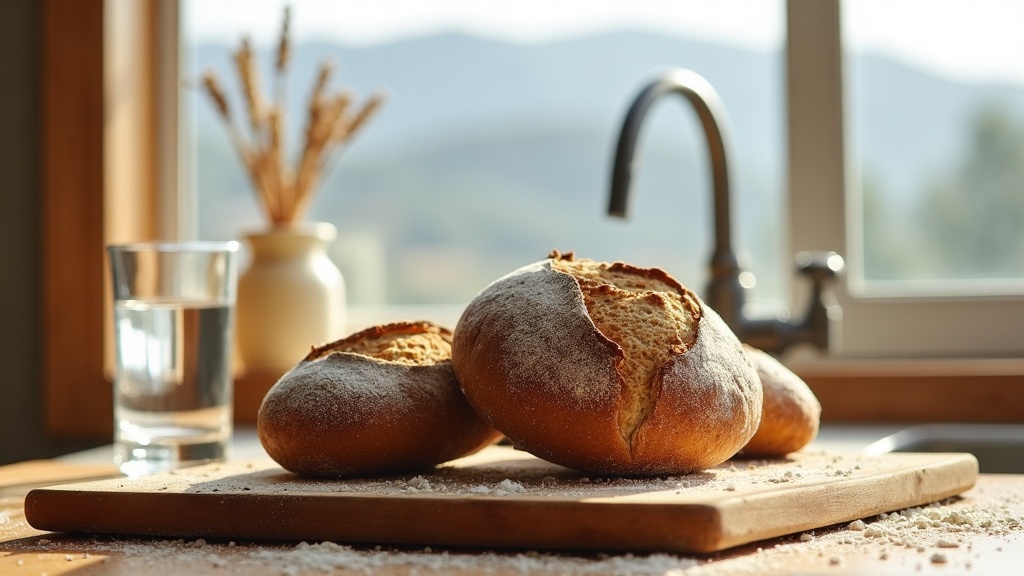
Home baking is having its biggest moment in years. In 2026, sourdough has moved from a pandemic hobby to a full-on lifestyle category. Bakery trend reports show sourdough is now a flavor platform, showing up in cinnamon rolls, croissants, and even donuts. The sourdough starter sitting on your counter is now a serious kitchen tool, not just a curiosity. And across the Treasure Valley, more people than ever are baking their own bread at home.
So why do so many Boise and Meridian home bakers keep hitting the same frustrating wall? Dense crumb. Dough that won't stretch. A starter that seems sluggish no matter what you feed it. You followed the recipe. You watched the videos. The person on YouTube made it look easy.
There is a good chance your water is working against you. Not in some subtle, abstract way. In a chemistry-backed, measurable way. Treasure Valley tap water runs 10 to 17 grains per gallon, and that mineral load has real effects on gluten development, yeast behavior, and fermentation. Here is what is actually happening in your dough.
The Water in Bread Is Not Passive
Most baking guides treat water as a neutral ingredient. Add 350 grams of water, mix, done. But water is not just hydration. It is the solvent that activates your yeast, dissolves your salt, and hydrates the flour proteins that form gluten. Whatever is dissolved in that water comes along for the ride.
For most Boise and Meridian households, what is dissolved in that water is a significant amount of calcium and magnesium. These minerals come from the volcanic basalt and limestone geology the Snake River Plain sits on. As water travels through that rock on its way to your tap, it picks up those ions. Boise city water typically measures between 10 and 15 grains per gallon (gpg). Meridian, drawing from deeper groundwater, commonly runs 12 to 17 gpg. Both put you firmly in the hard to very hard range.
The ideal water for bread baking sits around 50 to 150 parts per million of total dissolved minerals, roughly 3 to 8 gpg. Treasure Valley water is frequently double that or more. The difference matters at every stage of bread making.
What Hard Water Does to Your Gluten
Gluten is the protein network that gives bread structure. When flour and water come together, two proteins called glutenin and gliadin hydrate and link up into long, stretchy chains. Kneading or folding develops those chains further, creating a network that can trap the gas produced by yeast during fermentation. That trapped gas is what makes bread rise and gives it an open, airy crumb.
Calcium ions in hard water have a strengthening effect on this network. At moderate levels, around 100 to 150 ppm, that is actually a good thing. The minerals create extra cross-links between protein chains, giving the dough slightly more structure and helping it hold its shape during proofing.
Past that point, the cross-linking becomes excessive. Your gluten network gets over-tightened. The dough becomes stiffer than it should be, resists stretching when you try to shape it, and springs back aggressively. It is not a technique problem. The dough is literally less extensible because of what is in the water. During fermentation, that over-tightened network also constrains how much gas the yeast can trap, which limits your rise and gives you a denser crumb than the recipe intended.
If your bread dough always feels like it needs extra kneading to cooperate, or if your finished loaves consistently come out denser than the ones you see in tutorials, this is the likely explanation. The person in that video may be working with water at 80 ppm. Yours is closer to 250 ppm.
Chloramine and Your Sourdough Starter
This is where sourdough bakers run into a specific problem that sandwich-bread bakers often do not. Sourdough relies on a living culture of wild yeast and lactic acid bacteria. Those microbes are sensitive to disinfectants in tap water in a way that commercial packaged yeast is not.
Boise and most Treasure Valley cities use chloramine to disinfect municipal water. Chloramine is more stable than plain chlorine, which is part of why water utilities prefer it. The downside for sourdough bakers is that it does not evaporate. The old advice about leaving water out overnight to off-gas the chlorine does not work with chloramine. Your starter may be getting a dose of disinfectant every feeding if you are using tap water directly.
At low levels, the effect is subtle but cumulative. Over weeks and months, chloramine can slow fermentation, reduce the diversity of your starter's microbial community, and make your starter seem less vigorous than it should be. If your starter passes the float test but your dough still ferments slowly or produces less oven spring than you expect, chloramine is worth considering as a variable.
An activated carbon filter removes chloramine. A reverse osmosis system removes it along with the mineral load. Either one gives your starter a cleaner environment.
Hard Water and Bread Fermentation
Beyond gluten and starter health, very hard water also affects fermentation timing in ways that can throw off a recipe. Commercial yeast is more robust than wild yeast, but it still responds to its environment. Excess mineral content, particularly above 200 ppm, slows yeast activity by competing with the nutrients yeast needs and by altering the osmotic environment in the dough.
This means your bulk fermentation may take longer than the recipe suggests. The dough may look like it has risen adequately but not have developed the same flavor complexity or gas structure as it would in softer water. Home bakers who move to the Treasure Valley from cities with softer municipal water, like Portland or Seattle, frequently notice this adjustment period and assume they have done something wrong with their technique.
You have not done anything wrong. The water hardness here is a legitimate variable that affects fermentation rate, and accounting for it is part of baking in this climate.
The Fix for Boise Home Bakers
The most targeted solution for baking specifically is a reverse osmosis system under your kitchen sink. RO removes 90 to 95 percent of dissolved minerals and eliminates chloramine, bringing your water down to 10 to 50 ppm. At that level, your gluten develops more naturally, your starter ferments more predictably, and your dough handles the way the recipe expects. You use the filtered water for mixing dough and feeding your starter, while your regular tap handles everything else.
A whole-house water softener is the other common option. Softened water removes calcium and magnesium but replaces them with sodium. For most baking applications, softened water is a meaningful improvement over very hard tap water. Serious sourdough bakers sometimes prefer RO at the kitchen sink because the sodium in softened water creates its own interaction with yeast at high concentrations. Many Treasure Valley households end up with both: a softener for the whole house and RO under the kitchen sink for drinking and baking.
If you want to test the theory before investing in any equipment, try baking the same recipe with bottled spring water rated at 50 to 100 ppm total dissolved solids. If your dough is noticeably easier to work with and your loaf comes out taller and more open, your tap water was the variable. It is a simple experiment and it gives you a concrete answer about whether a water treatment solution makes sense for your kitchen.
If you are curious about what your Boise tap water actually contains, TrueWater Idaho offers a free in-home water test that gives you a current reading for your specific address, not just a citywide estimate.
Find Out What Is in Your Boise Tap Water
We offer a free in-home water test with no pressure and no sales pitch. Just a real hardness number for your address, so you know exactly what you are baking with.