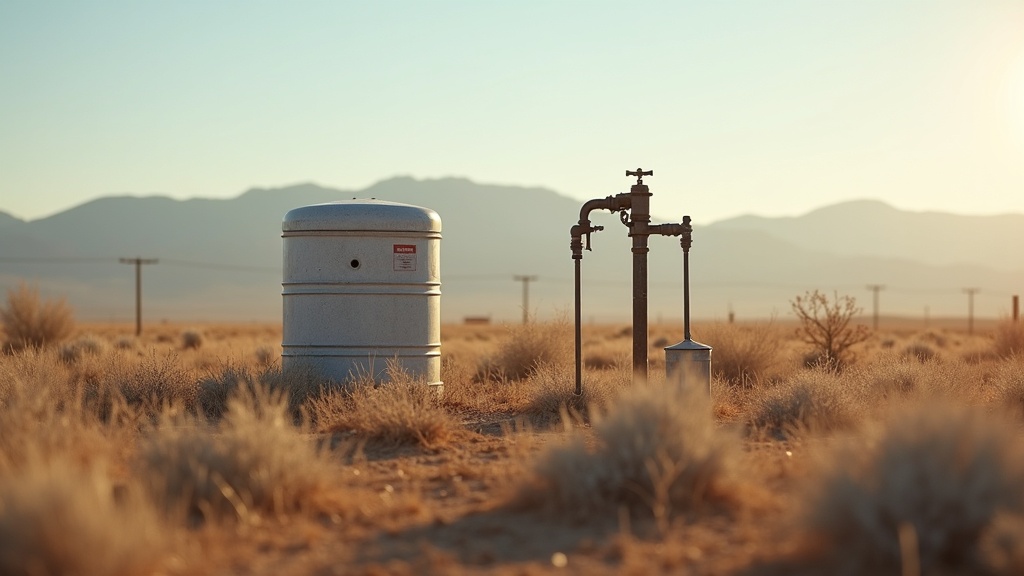
Why Uranium Shows Up in Treasure Valley Well Water
If you have a private well in Ada or Canyon County, there is a good chance uranium has never crossed your mind as a drinking water concern. Most people associate uranium with nuclear power plants or weapons programs, not the water coming out of their kitchen tap in Meridian or Star. But uranium in Treasure Valley groundwater is a real and well-documented issue, and the source has nothing to do with industrial activity.
The Treasure Valley sits atop an aquifer underlain by granitic sands and sediments that were deposited over millions of years. Uranium occurs naturally in granite, and as groundwater moves through those sediments, it slowly dissolves trace amounts of uranium from the surrounding rock. The process is entirely geological. Higher dissolved oxygen levels in shallower portions of the aquifer accelerate this dissolution, which is part of why residential wells, typically drilled at shallower depths than deep municipal supply wells, tend to show higher uranium concentrations.
There is no clean geographic line separating "safe" zones from "risky" ones. Idaho Department of Water Resources (IDWR) sampling data shows uranium scattered across both Ada and Canyon Counties, with results varying significantly from well to well, even within the same neighborhood. A home in Eagle might test clean while a property half a mile away exceeds the EPA limit. Depth matters, local aquifer conditions matter, and the only way to know for certain is to test.
Shallow residential wells, generally those completed above 200 feet, face the greatest exposure. Deeper municipal systems draw from different aquifer zones and are subject to treatment and regulation under the Safe Drinking Water Act. Private well owners in Nampa, Caldwell, Kuna, Middleton, and unincorporated areas of both counties are the population most at risk because their water is untreated and unmonitored by any regulatory agency.
The Numbers You Need to Know
The EPA established a Maximum Contaminant Level (MCL) of 30 micrograms per liter (µg/L) for uranium in drinking water under the Radionuclides Rule, finalized in 2000. That limit applies to public water systems. Private wells are not regulated under the Safe Drinking Water Act, which means the responsibility for testing and treatment falls entirely on the homeowner.
Research from Boise State University and the Idaho Department of Water Resources paints a sobering picture of what is actually in Treasure Valley groundwater. Across sampled wells in the Treasure Valley aquifer system, the mean uranium concentration was approximately 17.8 µg/L and the median was around 7 µg/L. That median sounds manageable, but the distribution has a long tail: the highest recorded sample reached 240 µg/L, more than eight times the EPA limit.
Roughly 17% of all sampled Treasure Valley wells exceeded the 30 µg/L MCL. But that aggregate number masks significant county-level variation. Ada County domestic wells showed exceedance rates of approximately 37%, meaning more than one in three tested wells came back above the federal limit. Canyon County wells exceeded the MCL at a lower but still significant rate of approximately 15.5%.
These are not small numbers. If you have a private well in Boise, Eagle, Kuna, or the unincorporated areas east of Meridian, the statistical odds that your water exceeds the EPA limit are meaningful enough to warrant a test. This is not a fringe concern for a handful of properties. It is a region-wide groundwater characteristic that tens of thousands of households need to be aware of.
Health Risks of Long-Term Uranium Exposure
Most people assume uranium is dangerous primarily because of its radioactivity, but the EPA's MCL for uranium is actually based on its chemical toxicity, not radiation. The kidneys are the primary target organ. Uranium accumulates in renal tissue, and long-term consumption of water exceeding the MCL is linked to chronic kidney disease and, at elevated concentrations, increased cancer risk.
Children face elevated risk for two reasons. Developing kidneys are more sensitive to chemical contaminants, and children consume significantly more water relative to their body mass than adults. A six-year-old drinking the same uranium concentration faces a proportionally higher exposure than an adult drinking the same water. Households with young children in Ada or Canyon County should treat uranium testing as non-negotiable.
One important point worth underscoring: there are no immediate symptoms from uranium exposure in drinking water. You will not taste it, smell it, or feel it in the short term. The damage accumulates slowly over years of daily consumption. Routine testing is the only reliable early warning system available to private well owners, which is exactly why we encourage annual testing for any household on a private well in the Treasure Valley.
Research published by Columbia University in recent years found detectable kidney damage biomarkers in study participants at uranium concentrations even below the 30 µg/L MCL, suggesting the safe threshold may be lower than the current regulatory standard. That finding does not change what you need to do today, but it does reinforce that even results modestly below the MCL are worth monitoring.
How to Test Your Well for Uranium in the Treasure Valley
Private wells in Idaho are not automatically tested for uranium. There is no state agency monitoring your well on your behalf. The testing responsibility falls on you as the homeowner, and that testing requires a deliberate effort because uranium will not show up on a standard bacteria or nitrate test.
When you contact a certified drinking water laboratory, ask specifically for a full radionuclide panel, not just a basic water quality screen. The Idaho Department of Health and Welfare maintains a list of state-certified drinking water laboratories in the Boise area that can process uranium samples correctly. The Idaho Dept of Health and Welfare has also periodically offered free private well testing programs that include uranium; checking their current offerings is worth a few minutes of your time.
As a general rule, we recommend testing at these key moments: when purchasing a home on a private well, annually if you have children under 18 or anyone in the household with kidney disease, and after any significant nearby drilling activity or changes in water taste or appearance. Annual testing is a small investment relative to the cost of treating kidney disease or dealing with a contamination problem that has gone undetected for years.
We also want to flag that uranium in Treasure Valley wells frequently co-occurs with arsenic and elevated nitrates. If your test comes back with uranium above the MCL, request a full contaminant panel before selecting a treatment system. The treatment approach may need to address multiple contaminants at once. You can learn more about nitrate concerns specifically in our article on nitrate testing for Idaho well water.
Treatment Options That Actually Remove Uranium
Not all water treatment systems are effective against uranium, and some of the most common household systems do nothing at all for radionuclides. Understanding what works and what does not will save you from spending money on equipment that leaves you no safer than before.
Reverse osmosis (RO) is the most well-documented treatment option for uranium removal. WHO data indicates that a properly installed, NSF/ANSI 58 certified RO system removes 90 to 99% of dissolved uranium. Point-of-use RO systems installed under the kitchen sink are the most common residential solution, providing treated water at the tap used for drinking and cooking. When evaluating systems, confirm the unit carries NSF/ANSI 58 certification specifically for radionuclide reduction.
Ion exchange using anion exchange resin is the other highly effective option. Treasure Valley groundwater tends to carry uranium in the uranyl form, which is an oxidized species that anion exchange resins capture well. For households with uranium readings significantly above the MCL, a combined approach using ion exchange followed by RO delivers the deepest reduction and provides redundancy if one system underperforms.
What does not work: standard water softeners, carbon block filters, UV disinfection systems. These are excellent for the problems they are designed to address, but none of them remove dissolved uranium. We see homeowners occasionally assume that because they have a whole-home softener their water is comprehensively treated. Softeners target calcium and magnesium hardness. They do not touch radionuclides.
If you are curious about how water softening fits into a broader treatment plan for Treasure Valley water quality, our guide on water softener installation in Nampa, Idaho covers the hardness side of the equation in detail.
Regardless of which treatment system you install, retest your water three to six months after installation. Confirm that uranium levels have dropped to an acceptable range. Equipment can malfunction, membranes can degrade, and installation errors happen. A post-installation test is the only way to verify the system is performing as intended.
Canyon County vs. Ada County: Does Your Location Matter?
The short answer is yes, but not in a way that should make Canyon County residents complacent. Ada County shows higher exceedance rates, approximately 37% of tested domestic wells, compared to roughly 15.5% in Canyon County. But 15.5% is not a small number. It means roughly one in six tested Canyon County wells exceeded the EPA limit. Residents of Nampa, Caldwell, Middleton, and Emmett on private wells have a meaningful probability of elevated uranium and should test accordingly.
In Ada County, the risk is concentrated but not confined to any single community. Eagle, Star, Kuna, and the areas east and south of Boise where private wells remain common show the highest testing priority. The 37% exceedance figure for Ada County domestic wells is striking and should remove any doubt about whether testing is necessary.
Well depth is one of the strongest predictors of uranium concentration. Shallow completions under 200 feet carry more risk because they draw from the upper aquifer zones where uranium dissolution is most active. If you know your well depth and it falls under 200 feet, move testing up your priority list.
One important clarification: residents of Boise, Meridian, Nampa, and Caldwell who receive municipal water service are not in this risk category. Public water systems are regulated under the Safe Drinking Water Act, tested regularly, and treated as needed. The uranium concern we are describing applies almost exclusively to private well users in both counties.
What to Do If Your Test Comes Back High
First, a result above 30 µg/L does not mean you or your family are in immediate danger. Uranium toxicity is a function of long-term cumulative exposure, not a single exposure event. What a result above the MCL does mean is that you should stop daily untreated consumption and move to a solution promptly.
In the short term, use bottled water or an NSF/ANSI 58 certified pitcher filter rated for radionuclide reduction while you arrange a permanent solution. This covers drinking and cooking water while you evaluate your options.
Order a full contaminant panel if you have not already. Uranium often co-occurs with arsenic and nitrates in Treasure Valley groundwater, and a treatment system selected without knowing the full picture may not address all the contaminants present. Get a complete picture before committing to equipment.
When evaluating treatment systems, get two to three quotes and ask each provider directly whether the proposed system is NSF/ANSI 58 certified for uranium removal. That certification is not optional; it is the standard that verifies the system performs as advertised. Be cautious of any provider who cannot answer that question clearly.
After installation, schedule a retest at three to six months. Confirm reduction to a level you are comfortable with. If uranium was your only concern and the retest shows levels well below the MCL, you can shift to annual retesting. If you had co-occurring contaminants, test for those as well to confirm the system is handling everything it was designed to address.
The EPA's radionuclides in drinking water page is a solid reference for understanding the regulatory framework, and the Idaho Department of Health and Welfare's drinking water resources include information on certified labs and testing programs specific to Idaho. We recommend bookmarking both if you are working through this process.