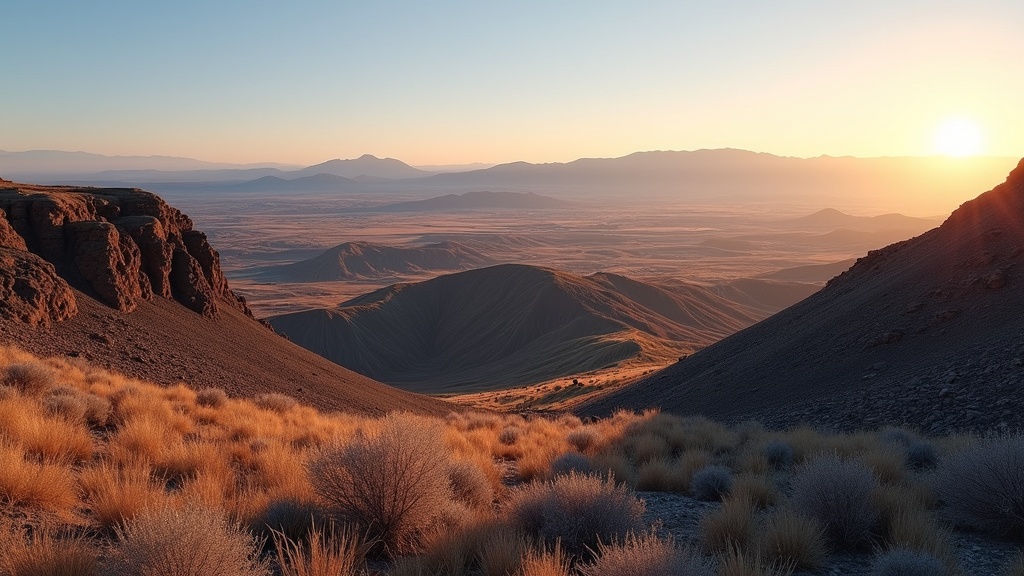
A Surveyor Stood on a Volcano and Drew the Lines
On May 1 and 2, 2026, the BLM, the Idaho State Historical Society, and Idaho Public Television gathered at a small volcanic butte about 15 miles south of Boise to mark an anniversary most Idahoans have never heard of. Governor Brad Little declared May 1 "Boise Meridian Initial Point Celebration Day." The event was part of America's 250th anniversary programming, but the history it honored goes back to 1867.
That year, Surveyor General Lafayette Cartee climbed to the top of that butte and fixed Idaho's principal meridian, the north-south line from which every property boundary in the state is measured. Every farm, every subdivision, every lot in the Treasure Valley traces back to that single point on a volcanic rock formation.
The fact that he chose a volcanic butte was not incidental. It was the highest, most visible landmark on a vast flat plain. And that plain is volcanic all the way down, something that matters a great deal if you are a homeowner in Meridian, Nampa, or Boise wondering why your shower doors look like they were frosted with chalk.
Why They Called It "Treasure Valley"
The name "Treasure Valley" is younger than most people assume. Pete Olesen, a Caldwell seed company owner, coined it in 1959. He was thinking about agricultural richness: fertile soil, irrigation canals fed by the Snake River, a climate that could grow everything from onions to hops. The treasure he had in mind was what came out of the ground, not what went into the water.
What Olesen did not factor in, and what nobody was advertising, was that the same volcanic geology producing all that fertility was also loading the region's groundwater with calcium, magnesium, iron, and bicarbonate. The minerals that break down into rich topsoil do not stop at the surface. They go all the way down, into the aquifer that most Treasure Valley homes draw their water from.
The treasure and the hard water have the same origin story.
What Is Actually Under the Ground
The Treasure Valley sits on the Snake River Plain, one of the younger volcanic features in North America. Beneath the farms and subdivisions, the geology is fractured basalt layered with volcanic ash and sediment, all of it stacked over millions of years of lava flows. This is not ancient, compressed rock. It is porous, fractured material with enormous surface area for water to move through slowly.
A USGS groundwater flow model updated between 2016 and 2023 traced how water moves through this system. The Snake River Plain aquifer is recharged primarily by flood irrigation and canal seepage; roughly 95% of new water entering the system comes from agricultural water delivery, not from precipitation. That water percolates downward through the fractured basalt for years, sometimes decades, picking up calcium, magnesium, iron, and bicarbonate as it moves.
By the time it reaches a well or enters a municipal treatment system, the water has been chemically shaped by the rock around it. This is not contamination. No one did anything wrong. The geology of the Snake River Plain is simply very good at dissolving minerals into groundwater, and those minerals are exactly what makes water "hard."
If you want to understand Treasure Valley water quality history, the geology is the whole story. The Initial Point butte Cartee stood on in 1867 is the same volcanic material responsible for the white buildup on your faucets today.
How Hard Is Treasure Valley Water?
Water hardness is measured in grains per gallon (GPG). The national average is around 3 GPG. Boise comes in at roughly 6.3 GPG. Meridian runs between 7 and 10 GPG depending on the source and the season. That puts the Treasure Valley at two to three times harder than the national average.
At those levels, the effects are visible and measurable. Water heaters accumulate scale on heating elements, and at 7 or more GPG, a water heater loses roughly 30% of its efficiency within a few years. Faucets and showerheads develop calcium deposits that restrict flow. Dishes come out of the dishwasher spotted. The white residue you see on any surface that gets wet and dries is a mineral signature: calcium and magnesium left behind as the water evaporates.
It is the volcanic geology leaving its calling card in your kitchen. You can read more about how GPG measurements work and what they mean for your home in our Treasure Valley water hardness scale guide.
The Valley Is Growing. The Aquifer Is Not.
In 2020, the Treasure Valley had roughly 688,000 residents. Current projections put that number above 1 million by 2040, a 53% increase in two decades. The water infrastructure is trying to keep up. A March 2026 Boise State University energy-water study flagged the region's water supply as a long-term pressure point. The Anderson Ranch Dam expansion, adding approximately 29,000 acre-feet of storage, is moving through planning as one response to that pressure.
More people drawing from the same aquifer does not change the mineral content of the water. The Snake River Plain basalt will keep loading the groundwater with calcium and magnesium regardless of how many subdivisions get built over it. What growth does change is how many households are dealing with hard water simultaneously, and how many water heaters, dishwashers, and plumbing systems are accumulating scale at the same time.
If you moved here from a softer-water region, the difference in your pipes and appliances shows up faster than you expect. That is not a Boise Water or Meridian City problem. It is the geology. For the full history of where Boise's municipal water actually comes from, see our earlier piece on Boise's water source history.
What You Can Do About It
The geology is permanent. Lafayette Cartee's survey lines are permanent. The Snake River Plain basalt is not going anywhere. What you can control is the water that enters your home after it comes out of the ground.
For homes in Meridian and Boise at 7 GPG or higher, a whole-home water softener is the standard solution. It removes calcium and magnesium through ion exchange before the water reaches your water heater, dishwasher, and fixtures. For drinking water specifically, a reverse osmosis system at the kitchen tap gives you filtered water independent of hardness level.
TrueWater offers free water tests for Treasure Valley homeowners. If you want to know exactly what your water contains and what the right solution is for your home, call us at (208) 968-2771. We test the water, explain what we find, and give you options without pressure.
Find Out What's In Your Water
We test your water on-site, walk you through what we find, and give you honest recommendations. No sales pressure. Just answers.