May 5, 2026 · Parenting / Family
The Baby-Proofing Checklist Everyone Knows (And Where It Stops)
You did everything right. Outlet covers on every socket. Cabinet locks under the sink and in the bathroom. A gate at the top of the stairs and one at the bottom, because why risk it. Corner guards on the coffee table. The oven lock that takes you three tries every time you want to preheat something.
That checklist exists because parents before us learned hard lessons. The hazards on it are real, documented, and worth every inconvenience. But that checklist was built around what you can see. A gap in a stair gate. A sharp corner. An unlocked cabinet door. It was designed for a different era of hazard awareness, before we understood what was flowing through the pipes inside the walls of nearly every home in America.
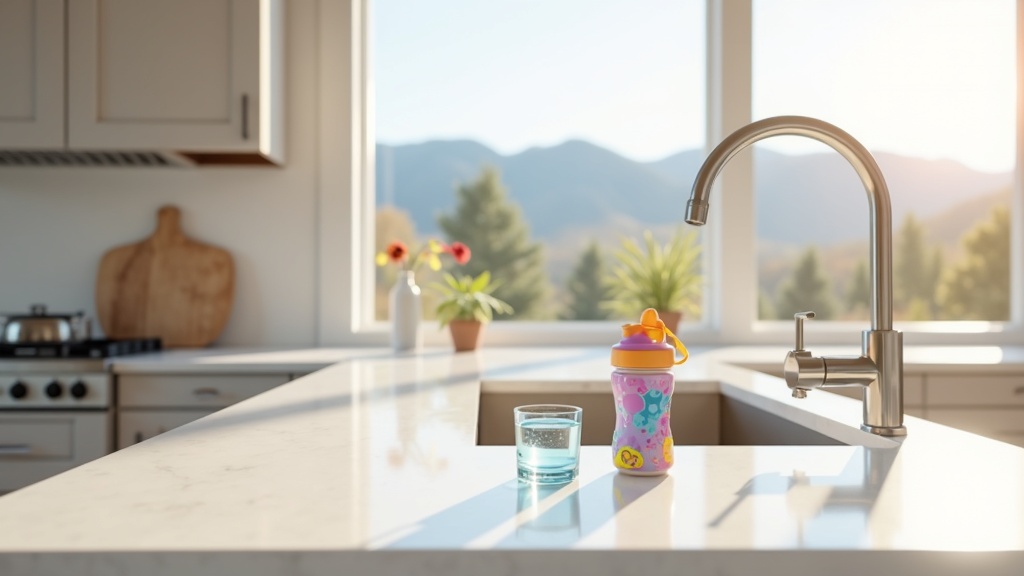
Here is the question worth sitting with: what if the most documented threat to your child's developing brain isn't something you can gate, lock, or pad? What if it's invisible, tasteless, and flowing from the same tap you use to fill their sippy cup?
The Invisible Hazard: Lead, PFAS, and Your Tap Water
In 2026, the EPA's Lead and Copper Rule Improvements (LCRI) went into effect. It's the most significant lead-pipe transition in U.S. history, requiring utilities to replace lead service lines within 10 years. The reason that rule exists is also the reason it matters for your family: millions of American homes still have lead in their plumbing infrastructure, and there is no safe level of lead exposure for children.
Not "very low is okay." Not "a little is probably fine." The EPA and CDC both state this clearly: no safe level. Even low-level exposure is associated with learning disabilities, reduced IQ, and ADHD. The damage is largely irreversible. And the cruel irony is that the water coming from your tap may look, smell, and taste completely normal while carrying measurable lead.
Then there's PFAS. These are the "forever chemicals" used in everything from nonstick cookware coatings to stain-resistant fabrics. PFAS have been detected in 99% of Americans, including newborns. Early exposure is linked to immune suppression, developmental delays, and hormonal disruption. They don't break down. They accumulate.
For Treasure Valley families, the picture is nuanced. Boise's municipal water meets federal standards, but third-party testing has flagged trace arsenic and hexavalent chromium in some samples. Homeowners in Canyon and Ada County who rely on private wells face real nitrate risk, particularly families with infants. Meeting federal standards is a floor, not a ceiling. For a developing child's brain, "technically legal" and "genuinely safe" are not the same thing.
You can read more about how local water quality compares at our post on what Treasure Valley pediatricians recommend for kids and tap water.
Hard Water and Your Child's Skin
Even if lead and PFAS weren't part of the equation, Treasure Valley water has one more quirk that affects kids directly: it's hard. Very hard. Boise typically runs 10 to 15 grains per gallon. Meridian runs 12 to 17 gpg. For context, anything above 7 gpg is classified as hard. We are living significantly above that line.
A meta-analysis published in PubMed found a positive association between hard water and childhood eczema. The mechanism isn't complicated: the calcium and magnesium mineral deposits in hard water disrupt the skin's natural pH barrier. Adult skin is resilient enough to mostly compensate. A baby's skin is thinner, more permeable, and less able to fight back. If your child has persistent dry, irritated, or rashy skin and your pediatrician has focused on diet or detergents without asking about your water, this connection may be worth raising.
It's also worth noting that hard water residue on baby bottles, formula pitchers, and sippy cups isn't a health risk on its own, but it's a signal. If your dishes are showing white mineral buildup, your baby's skin is being bathed in the same water every night.
The Upgraded Checklist for 2026
Here's the good news: everything you already did still counts. The outlet covers, the cabinet locks, the stair gates. Keep all of it. This isn't about replacing the standard checklist. It's about adding one layer that every baby-proofing guide has historically left out.
The water layer. And it starts with a test, not a purchase.
- Test for hardness so you know exactly where your Treasure Valley home sits on the scale.
- Test for lead, especially if your home was built before 1986, when lead solder in plumbing was still common.
- Test for nitrates if you're on a well, particularly important for infants under six months.
- Test for arsenic and PFAS if you want a complete picture. Third-party labs like the Idaho Department of Environmental Quality can point you toward certified testing options.
Once you know what's in your water, treatment options are straightforward:
- A whole-house water softener handles hardness throughout the home, which means every bath, every load of laundry, every glass of water your kids drink is softer. This is the primary solution for eczema and skin issues.
- An under-sink reverse osmosis system removes lead, arsenic, PFAS, nitrates, and most other dissolved contaminants at the point you actually drink from. This is the targeted solution for the developmental hazards.
- A combination system (softener plus RO) covers both bases. This is what we most commonly recommend for Treasure Valley families with young children.
For more on using filtered water specifically for infant formula preparation, we put together a detailed guide at baby formula and water quality for Idaho parents.
The baby-proofing guides haven't caught up to what the science knows. But you can. A water test takes about 20 minutes and costs nothing when you schedule it through TrueWater. It's the one item missing from every checklist you've ever read.
Common Questions from Treasure Valley Parents
Get the One Test Missing from Every Baby-Proofing Guide
We'll test your Boise or Meridian home's water at no charge. No pressure. Just clear answers about what's in your water and what, if anything, to do about it.