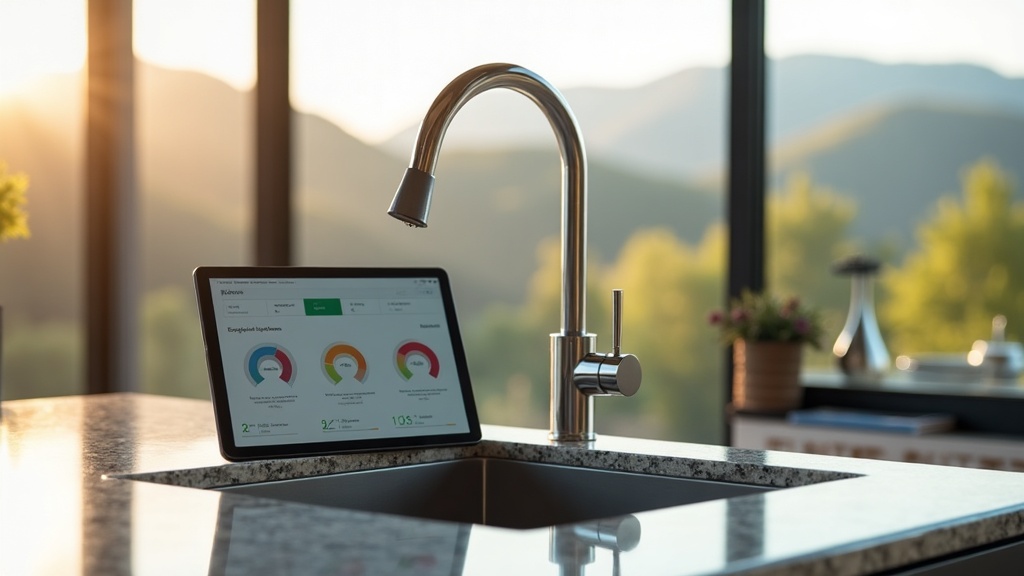
Walk through your house right now and count what it knows. The thermostat tracks temperature in every room. The Sense monitor on your electrical panel knows which appliances are running, how many watts each one draws, and whether your refrigerator compressor is starting to underperform. Your air quality sensor catches particulate spikes when you cook. Your sleep tracker logged how many times you woke up last night.
The average connected home in 2026 monitors somewhere around 47 data points simultaneously. Energy by appliance, room-by-room air quality, motion, sleep cycles, solar output, battery state of charge. If something changes in your house, there is a sensor somewhere watching it.
Except for one thing. The stuff coming out of your taps.
Your Home Has Never Known More About Itself
The past few years have been a genuine turning point for whole-home data. Platforms like Sense Energy Monitor and Enphase IQ Energy Management have moved beyond simple "how much electricity did I use this month" dashboards. They now use machine learning to fingerprint individual appliances, flag efficiency degradation before it becomes a breakdown, and tie energy consumption to real-time utility rates.
Other corners of the home have followed. Indoor air quality monitors track CO2, VOCs, humidity, and fine particulates. Smart irrigation controllers pull local weather data and adjust watering schedules automatically. Whole-home leak detectors sit on main water lines and can shut off the supply if they detect an unexpected flow pattern at 3am.
The result is that most modern homes in Boise and Meridian now have a continuous, data-rich picture of what is happening inside them. You can pull up an app and know, right now, exactly what your HVAC system cost you to run this week.
The One Data Stream Every Dashboard Is Missing
Here is the gap. Every one of those dashboards can tell you how much water flowed through your home. Leak detectors measure gallons per minute. Some smart meters track daily consumption. A few devices even track flow by fixture.
None of them can tell you what is in that water.
Water volume and flow are easy to measure with a sensor and a wireless radio. Water chemistry is a different problem entirely. Hardness, pH, total dissolved solids, iron content, and contaminant levels require either a chemical reaction, a spectroscopic measurement, or a lab. Consumer electronics have not cracked that yet at a price point or reliability level that makes it practical for a home dashboard.
So your smart home knows how many gallons your dishwasher used this morning. It has no idea whether those gallons were depositing a thin film of calcium carbonate on the heating element while it ran.
Why Water Quality Data Actually Matters for Your Home
This is not just a missing data point for its own sake. In the Treasure Valley, water quality has real consequences for the appliances and infrastructure your home depends on.
Water in Boise and Meridian comes primarily from the Snake River Plain aquifer. That aquifer runs through volcanic basalt geology that naturally leaches calcium and magnesium into the water supply. The result is water that measures 10 to 15 grains per gallon (gpg) of hardness in Boise and 12 to 17 gpg in Meridian. For reference, water above 7 gpg is generally classified as hard. We are running significantly above that baseline year-round.
There is also seasonal variation. Spring snowmelt dilutes mineral concentrations somewhat. Late summer and early fall, when water table levels drop and more groundwater is drawn, tends to push hardness toward the higher end of those ranges.
That hardness is doing something in your home right now. It is depositing scale on water heater elements, inside pipes, on showerheads, inside dishwasher spray arms, and throughout the internal components of your washing machine. Scale is an insulator. Your water heater works harder and costs more to run when its element is coated in mineral buildup. Your energy monitor sees the higher wattage draw. It just cannot tell you the reason.
The Five Numbers Every Boise Home Should Know About Its Water
If your home were actually generating water quality data the way it generates energy data, here is what you would want to see on that dashboard.
- Water hardness (gpg or mg/L): The single most impactful number for appliance longevity and efficiency in the Treasure Valley. Know your baseline and monitor it seasonally.
- Total dissolved solids (TDS, in ppm): A broader measure of everything dissolved in your water. Useful for understanding overall mineral load and verifying that a filtration system is performing correctly.
- pH level: Water that runs acidic (below 7.0) is more corrosive to copper pipes and fixtures. Alkaline water above 8.5 can accelerate scale deposits. The target range is 6.5 to 8.5 for residential water.
- Iron content (mg/L): Even small amounts of iron show up as rust stains on fixtures, laundry discoloration, and a metallic taste. Boise area well water in particular can carry elevated iron levels depending on the local geology.
- Contaminants specific to your source: City water in Boise and Meridian is treated, but treatment byproducts like trihalomethanes (THMs) are worth knowing. Well water should be tested for nitrates, bacteria, and arsenic, which can occur naturally in Idaho's volcanic geology.
The Gap Smart Home Tech Hasn't Closed Yet
To be straightforward about where things stand: consumer-grade home water quality monitoring is not there yet. A handful of inline TDS meters exist that connect to smart home platforms and give you a real-time dissolved solids reading. That is useful as a rough proxy, but TDS cannot tell you whether your solids are calcium (hardness) or something else entirely. It is like knowing your home used 40 kWh today without knowing whether that was your air conditioner or an appliance running abnormally.
More sophisticated water quality sensors exist for commercial and industrial applications, but they are priced and sized for treatment plants, not under a kitchen sink. The technology is improving, and it is reasonable to expect that accurate home water quality monitoring will exist at a consumer price point within a few years.
For now, the gap between what your smart home tracks and what it should track is real. Your Enphase app can tell you to the watt how hard your water heater worked today. It cannot tell you that the water heater is working 15 percent harder than it should be because of scale accumulation from 14 gpg Meridian water.
How to Get Your Home's Water Data Today
Since the dashboard does not exist yet, a professional water test fills the gap. A proper test gives you the actual numbers: hardness, TDS, pH, iron, and a panel of contaminants appropriate for your water source. It is the baseline your home is missing.
For most Treasure Valley homeowners on city water, testing once a year makes sense. If you are on a well, twice a year is smarter given seasonal variation in the Snake River Plain aquifer. You should also test any time you notice a change in how your water tastes or smells, after any plumbing work or municipal water main work in your area, or after installing a softener or filter to confirm it is actually doing what it is supposed to do.
We offer free water tests throughout the Boise and Meridian area. You get the actual data: hardness, pH, iron, TDS, and whatever else makes sense for your situation. No pressure, no sales pitch attached to the test. Just the numbers your home should already know.
Call us at (208) 968-2771 to schedule yours, or request a free test online. It takes about 20 minutes and gives you a starting point for the one data stream your smart home has been skipping.
Get Your Home's Water Data
Free water test for Boise and Treasure Valley homeowners. Know your hardness, pH, iron, and TDS. Takes about 20 minutes.
Frequently Asked Questions
Not yet, at least not in any meaningful chemical sense. Smart home platforms like Sense or Enphase track energy consumption and can infer appliance health, but they have no way to detect what is dissolved in your water. Some devices measure flow rate or detect leaks, but hardness, pH, TDS, and contaminants require either a dedicated sensor or a professional lab test. Consumer-grade water quality sensors exist, but none have reached the reliability or mainstream adoption of a smart thermostat or energy monitor. For now, professional testing is still the most accurate way to know what is in your water.
The five numbers that matter most for a Boise or Treasure Valley home are: water hardness (Boise typically runs 10 to 15 grains per gallon, Meridian 12 to 17 gpg), total dissolved solids (TDS), pH level, iron content, and any contaminants specific to your water source. Hardness is the big one locally because the Snake River Plain aquifer pushes high mineral content into the water supply year-round. Knowing your TDS and pH helps you understand whether a filter or softener is actually doing its job.
Hard water leaves mineral scale inside water heaters, dishwashers, washing machines, and ice makers. That scale acts as insulation, forcing heating elements to work harder and run longer to reach the same temperature. Your energy monitor will see those appliances pulling more watts over time, but it will not know why. A water heater that should use a certain amount of energy per month can cost significantly more to run after a few years of scale buildup. Treating the water addresses the root cause rather than just watching the symptom on a dashboard.
For most Treasure Valley homeowners on city water, a baseline test once a year is a reasonable starting point. The Snake River Plain aquifer has seasonal variation, meaning mineral concentrations can shift between spring snowmelt and late summer. If you are on well water, testing twice a year is smarter. You should also test any time you notice a change in taste, smell, or appearance, after a water main break or boil notice in your area, or after installing a new treatment system to confirm it is working correctly.
A few devices are on the market, including inline TDS meters and basic flow monitors that connect to home automation systems. They can tell you total dissolved solids in real time, which is a rough proxy for overall water quality. However, they cannot distinguish between mineral hardness and other dissolved compounds, and they will not detect specific contaminants like iron, bacteria, or nitrates. Think of them as a first alert system rather than a diagnostic tool. A professional water test gives you the full picture; a smart sensor lets you watch for big changes between tests.