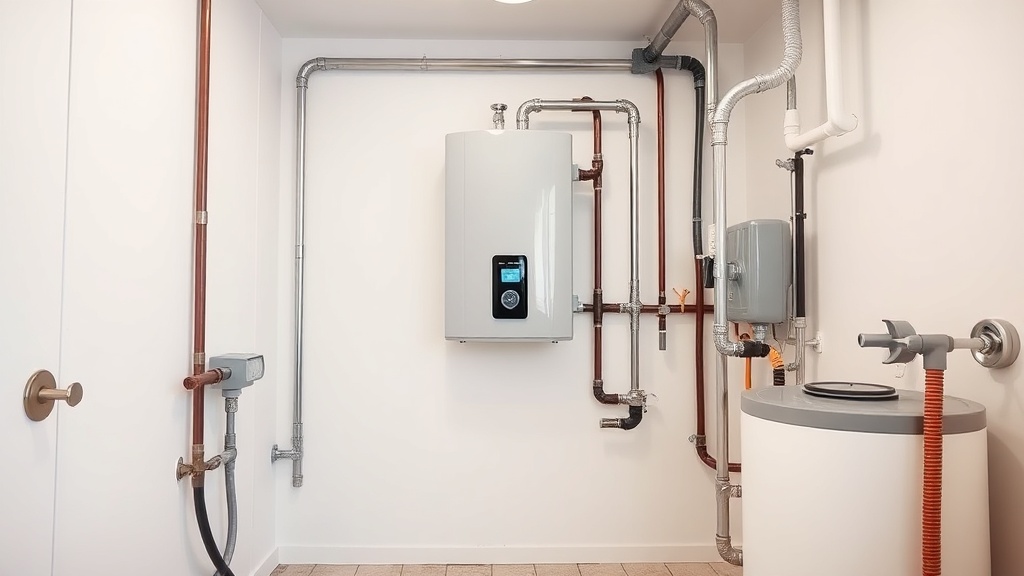
There is a sound that Idaho homeowners often describe as popping or rumbling coming from the water heater, usually louder at night when the house is quiet. Most people assume it is a normal quirk of an aging appliance. It is not. It is the sound of a water heater working significantly harder than it should because of scale buildup, and it is costing money every month while shortening the life of a major appliance.
In Meridian and Boise, where tap water runs 8.4 to 10 grains per gallon of hardness, scale accumulation in a water heater is not a question of if. It is a question of how fast and how much it will cost you before you address it.
Why Scale Forms Inside Water Heaters
Calcium and magnesium stay dissolved in cold water without much trouble. Heat changes everything. When water is heated above roughly 140 degrees Fahrenheit, those dissolved minerals precipitate out of solution and begin bonding to whatever surface they contact. In a tank water heater, that surface is the bottom of the tank and the heating element itself.
Every time your water heater cycles on, it adds another thin layer of mineral deposits to the surfaces inside. Over months and years, those layers build into a thick insulating blanket of calcium carbonate. In Idaho, this process happens faster than in most of the country because your source water carries a higher mineral load to begin with.
What Scale Does to Heating Efficiency
The U.S. Department of Energy has studied scale's impact on water heater efficiency in detail. Their findings are straightforward: just a quarter inch of scale on a heating element forces the element to consume approximately 29 percent more energy to heat the same amount of water. A half inch of scale pushes that figure above 40 percent.
Think about what that means practically. If your water heater accounts for 18 percent of your home's energy use, scale buildup alone could add three to seven percent to your total energy bill every month. In a Boise winter, that adds up quickly.
The popping and rumbling sound is scale-related too. When water becomes trapped under the layer of mineral deposits and gets superheated, it creates small steam pockets that collapse suddenly. That is the noise. It is not dangerous by itself, but it is a reliable sign that scale has built up significantly.
How Scale Shortens Water Heater Lifespan
A standard tank water heater installed in a home with treated or soft water can realistically last 10 to 13 years. Consumer Reports and most appliance manufacturers cite 8 to 12 years as the average lifespan under normal conditions.
Idaho homeowners on untreated hard water routinely see failures at 5 to 8 years. The mechanism is straightforward. The heating element, constantly running hotter and longer to overcome the insulating scale layer, experiences accelerated thermal stress. The tank lining degrades faster under repeated high-temperature cycling. The anode rod, which protects the tank from corrosion, gets consumed more quickly in hard water.
A replacement tank water heater in the Treasure Valley currently costs $900 to $1,600 installed. Replacing one at year six instead of year twelve means paying for two water heaters in the time span that should have required one.
The Annual Flush: What It Does and When It Is Too Late
Most plumbers recommend flushing your water heater tank once a year to remove sediment. This involves connecting a hose to the drain valve, letting the tank empty, and flushing the accumulated sediment out the bottom. In soft water areas, this is relatively straightforward.
In hard water areas like Meridian and Boise, a few things complicate it. First, scale that has hardened and bonded to the tank lining does not flush out. A flush removes loose sediment, not cemented scale. Second, if the drain valve has not been used in several years, it is often corroded or partially blocked and can leak after being opened. Third, if scale has built up enough to cause the popping sounds described earlier, flushing the sediment will not meaningfully reverse the efficiency loss.
An annual flush is worth doing as part of maintenance. But it is not a substitute for softening the water before it enters the heater. Prevention is the only approach that actually works.
Tankless Water Heaters and Hard Water
Many Idaho homeowners upgrading from a tank unit assume that going tankless eliminates the scale problem. The opposite is true. Tankless water heaters are more vulnerable to scale damage than tank units, not less.
A tankless unit heats water on demand by passing it through a narrow heat exchanger at high velocity. The heat exchanger has very small flow passages, and scale buildup restricts them quickly. A restriction of just 20 percent in flow through a heat exchanger can trigger error codes and force the unit into reduced-output mode. Scale can also cause hot spots in the heat exchanger that lead to premature failure.
Tankless water heater manufacturers including Rinnai, Navien, and Rheem all specify maximum water hardness levels in their warranty documentation, typically 11 to 15 GPG. Some require annual descaling service in hard water areas as a warranty condition. In Idaho, installing a tankless water heater without addressing hardness first is an expensive mistake.
Softening the water before it reaches a tankless unit is essentially required if you want the unit to perform as advertised and last its expected 15 to 20 year lifespan.
The Real Cost Comparison
A water softener installed in an Idaho home typically runs $1,200 to $2,000 depending on the size and brand. Salt costs average $200 to $400 per year. Over ten years, total cost including installation and salt runs roughly $3,200 to $6,000.
An unsoftened home that loses one water heater early, pays 29 to 40 percent more in water heating energy, uses more detergent and cleaning products, and potentially damages a dishwasher or tankless unit will spend significantly more than that over the same period.
The water softener pays for itself. The math works in most Idaho homes within three to five years when you account for all the downstream costs of untreated hard water.