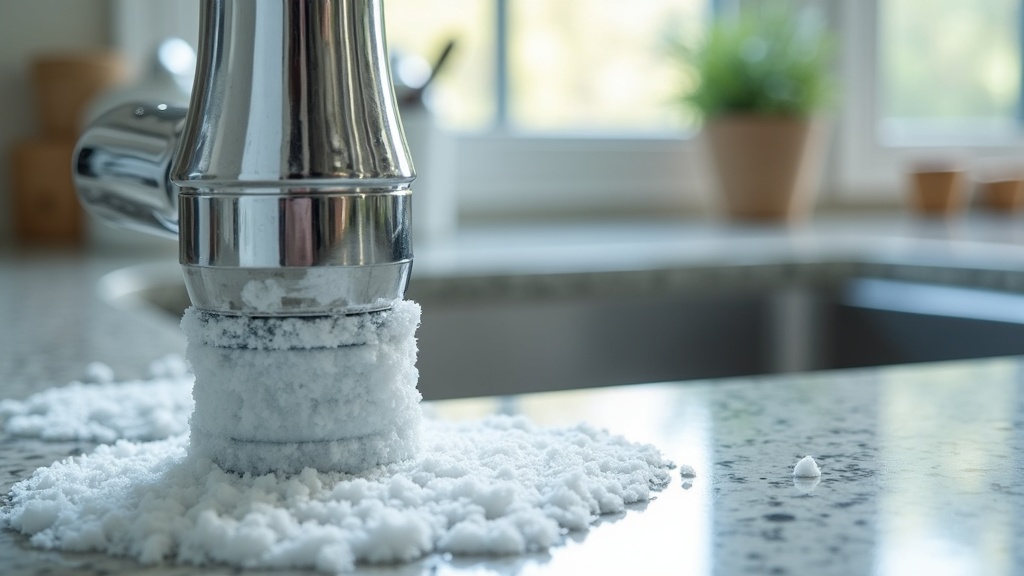
Faucet Replacement from Hard Water in Boise
If you've scrubbed white crust off your faucet more than once this year, or your kitchen handle now takes real effort to shut off a drip, you're not dealing with a cheap faucet problem. You're dealing with a water problem. Here's what's actually happening inside your fixtures, what it costs to ignore it, and what stops the cycle for good.
Why Boise and Meridian Water Destroys Faucets Faster Than the National Average
Boise city water tests between 10 and 15 grains per gallon (gpg) of hardness. Meridian runs higher, between 12 and 17 gpg. For context, the USGS classifies anything above 7 gpg as hard water. Treasure Valley water is not just hard. It is running at nearly double that threshold, and in Meridian it often exceeds double.
The reason comes down to geology. The Snake River Plain sits on layers of basalt and volcanic rock left behind by ancient lava flows. As groundwater moves through that aquifer, it picks up calcium and magnesium. By the time that water reaches your tap, it carries a significant mineral load. This is not a treatment failure or an infrastructure problem. It is simply what the landscape here produces.
What that means practically: calcium carbonate and magnesium deposits begin accumulating inside your plumbing from day one. A home that has been on Meridian city water for five years without a softener has five years of mineral layering inside every faucet, valve, and appliance it has. Homes built during the 2016 to 2021 Treasure Valley growth boom are now hitting that five to ten year mark, and we are seeing a surge in faucet failures that are entirely predictable given the local water chemistry.
To understand how Treasure Valley water quality compares city to city, the numbers tell a clear story: nearly every household in the Boise metro is above the threshold where faucet lifespan is shortened.
What Actually Fails Inside Your Faucet (A Plumber's Breakdown)
Hard water does not destroy a faucet all at once. It works through the components in a predictable sequence, which is why problems tend to compound over time rather than show up suddenly.
- Aerator screen. This is the small mesh insert at the tip of your spout, and it is almost always the first casualty. Calcium packs the mesh until flow drops to a trickle or becomes uneven. Many homeowners soak it in vinegar, which helps temporarily, but in water at 12 to 17 gpg the problem returns within weeks.
- Cartridge and valve stem. Behind the handle sits the cartridge, a ceramic disc mechanism that controls water flow. Mineral grit works into the moving surfaces and grinds the ceramic, causing both drips and a handle that takes increasing force to operate. This is the component most commonly replaced in a "faucet repair" call.
- Valve seat. Calcium bonds directly to the brass valve seat inside the body of the faucet. Once that bond forms, the cartridge cannot create a clean seal, and the drip returns even after a new cartridge is installed.
- O-rings and seals. The rubber components that prevent leaks around the spout and base rely on staying pliable. Scale abrades rubber over time, accelerating cracking and causing the base-of-faucet leak that looks like a slow weep around the counter.
- Supply line fittings and shutoff valves. This is the hidden problem that turns a simple faucet swap into an expensive job. Scale locks the compression ferrules on supply lines and freezes shutoff valves in the open position. When a plumber cannot shut off water at the valve under the sink, the repair now involves the shutoff valve too, often requiring a wall or cabinet cutout.
Each of these failures is slow individually. Together, over five to eight years of hard water exposure, they add up to a faucet that is functionally at end of life even if it looks intact from the outside.
The Real Cost of Letting Hard Water Buildup Go Unaddressed
Plumber rates in the Boise and Meridian area have risen sharply over the past few years. A standard faucet replacement, including labor and parts for a single fixture, now runs $260 to $480 in most cases. For a complex job where the shutoff valve is seized or access is difficult, that number can reach $1,600.
Without a water softener, faucet lifespan in Treasure Valley water typically falls to three to five years rather than the ten to fifteen years a faucet is designed to last. Consider a Meridian homeowner with three bathrooms and a kitchen, each with a single faucet. In softened water, those faucets might need replacement once per decade: a one-time expense of perhaps $1,200 to $1,800 spread over ten years. With untreated 14 gpg water, the same homeowner may be replacing those faucets every four years, running the same cost every cycle, indefinitely.
The hidden cost that most people do not see until it is too late: seized shutoff valves discovered only when a plumber shows up for a faucet swap. A frozen valve that has not been operated in years adds $150 to $300 per occurrence to any repair bill, and in older Treasure Valley homes it is more common than not.
These are honest numbers. We are not trying to sell fear; we are trying to give you the actual math before you schedule the next service call.
Signs Your Faucet Damage Is Already at the Point of Replacement
Not every crusty faucet needs to be replaced. But certain signs indicate the damage has moved past what a cartridge swap will fix:
- • White or orange crust around the base that cleaning cannot remove. If it is bonded to the finish and underneath it, the mineral intrusion has reached the body of the faucet itself.
- • Slow or gurgling flow even when house pressure is normal. Upstream pressure from other fixtures is fine, but this one runs weak. The aerator and internal passages are packed.
- • Handle requiring increasing force to stop a drip. The valve seat or cartridge disc is compromised. More force compensates temporarily, but it accelerates wear on what is left.
- • A new drip reappearing within weeks of a cartridge swap. This is the clearest indicator that the valve seat has calcium bonded to it. No cartridge will seal against a pitted seat.
- • Finish pitting, bubbling, or delaminating around the spout or base. The finish failure is cosmetic, but it signals that the underlying brass has been exposed to mineral attack long enough to cause structural compromise.
If you are seeing two or more of these, the conversation with a plumber is likely going to end with a replacement recommendation regardless.
Repair vs. Replace: How a Plumber Makes the Call in Idaho Hard Water Conditions
The decision framework used by most plumbers working Boise and Meridian jobs comes down to a few clear checkpoints:
- • Under five years old with no visible scale intrusion on the body. A new cartridge is worth one attempt. The faucet has years of useful life if the repair holds.
- • Five or more years with visible scale on internal components. Replacement usually wins on cost over the next two to three years, especially if labor rates are rising in your area.
- • Finish delamination or base corrosion present. Repair only at this stage. There is no patch for compromised metal.
- • Seized shutoff valve confirmed before work begins. What started as a $150 repair becomes a $400 to $600 job. At that cost point, replacement is almost always the better value.
The general rule of thumb: if the estimated repair cost exceeds 50% of the cost of a new faucet plus installation labor, replace it. In Idaho hard water conditions, that calculation tips toward replacement sooner than it would in a softer-water market like Seattle or Portland.
How a Water Softener Stops the Cycle of Faucet Replacement
A water softener addresses the problem at the source rather than at the fixture. Through a process called ion exchange, the softener swaps calcium and magnesium ions for sodium ions as water enters the home. By the time water reaches your faucets, the mineral load that causes scale has already been removed.
The practical effect on faucets is significant. Aerators stay clear. Cartridges move smoothly because there is no mineral grit grinding against ceramic surfaces. O-rings and seals stay pliable because they are not being abraded by calcium particles. Valve seats remain clean, so cartridges seal properly the first time and continue sealing for the life of the part.
A faucet in softened water in Meridian or Boise returns to its designed lifespan of ten to fifteen years. That is not a manufacturer claim for soft-water regions. It is what we see in homes here when the hardness is brought under 1 gpg at the point of entry.
The benefit is not limited to faucets. Every fixture, appliance, and water-using device in the home operates with the same protection simultaneously. Water heaters, dishwashers, washing machines, and shower heads all benefit from the same ion exchange happening at the point of entry. To understand the mechanics in more detail, our guide on how a water softener works walks through the process step by step.
According to EPA guidance on water quality, addressing mineral content at the whole-home level is the most effective way to protect plumbing infrastructure long-term. Treasure Valley water chemistry makes that more than a recommendation. It makes it a financial decision.
What to Expect When TrueWater Tests Your Water
We offer a free in-home water test that takes twenty to thirty minutes. No pressure, no commitment on your end. We bring the testing equipment, run the analysis at your tap, and give you the results before we leave.
What the test measures: exact hardness in grains per gallon, iron presence, total dissolved solids (TDS), and pH. These are the numbers that determine what your water is doing to your plumbing, your appliances, and your skin and hair.
If your hardness comes back above 7 gpg, which includes nearly all households on Boise city water and virtually every household on Meridian city water, the return on investment for a softener typically falls under three years when you account for avoided plumbing repairs, appliance lifespan extension, and reduced soap and detergent use.
We serve Boise, Meridian, Eagle, Nampa, Caldwell, Kuna, Star, and Garden City. If you are in the Treasure Valley and on city water, your hardness level almost certainly qualifies. The test just confirms the exact number and lets you make the decision based on your specific water, not a regional average.
Before you pay for another faucet replacement, find out what your water is actually doing to everything in your home.
A free 20-minute water test gives you the exact hardness number, iron level, and TDS for your Treasure Valley home, with no obligation.
Frequently Asked Questions
How can I tell if my Boise faucet is damaged by hard water versus just worn out?
Hard water damage has a few tells that regular wear does not. White or orange mineral deposits around the base and spout, reduced flow despite normal house pressure, a drip that came back within a few weeks of a cartridge replacement, and a handle that requires noticeably more force over time are all hard water indicators. Regular wear typically shows up as a single drip from an aging cartridge without the crusty buildup, the flow restriction, or the recurring failure pattern. In Boise and Meridian, if your faucet is more than five years old and showing two or more of those symptoms at once, hard water is almost certainly the primary cause.
Is it worth replacing a faucet if I do not have a water softener yet?
It can be, depending on your situation. If a faucet has failed and is leaking, replacement is necessary regardless. But if you replace the faucet without addressing the water hardness, you are starting the clock on the same damage cycle again. In Meridian water at 12 to 17 gpg, a new faucet installed without a softener will likely show the same mineral buildup issues within three to five years. If you are replacing one faucet now, it is worth at least getting a water test before you spend money on the others. That way you are making the next decision with your actual hardness number in hand rather than guessing.
How long do faucets last in Meridian with untreated water vs. softened water?
In untreated Meridian water, which typically runs 12 to 17 gpg, faucet lifespan drops to roughly three to five years before meaningful repair or replacement is needed. In softened water, where hardness is brought below 1 gpg at the point of entry, faucets routinely reach the ten to fifteen year lifespan they are designed for. That gap represents two to three full replacement cycles avoided over a decade, which in current Meridian plumber rates translates to a real dollar figure worth calculating before your next service call.
Can I just clean the aerator and cartridge myself instead of calling a plumber?
Yes, and for a faucet that is relatively new or just starting to show flow restriction, DIY maintenance is a reasonable first step. Soaking the aerator in white vinegar for several hours dissolves calcium deposits. Cartridge replacement is a straightforward job on most common faucet brands with basic tools and a parts store run. The limitation is that vinegar cleaning is temporary when hardness is above 10 gpg; buildup returns quickly. And if the valve seat has calcium bonded to it, no amount of cleaning restores a proper seal. DIY is worth trying on newer faucets. On faucets over five years old with the full symptom picture, it often delays rather than solves the problem.
Will a water softener fix the damage that has already happened to my faucet?
A softener stops future damage from that point forward; it does not reverse damage that has already occurred. Calcium bonded to a valve seat stays there. A cracked O-ring stays cracked. A pitted finish does not restore itself. What the softener does is stop the accumulation cycle, which means the faucets you replace now or repair now will last as long as they are supposed to. The practical approach most Treasure Valley homeowners take: install the softener, then prioritize which faucets are actively failing for repair or replacement, and let the healthy ones run their remaining life out now that the water chemistry is working in their favor.