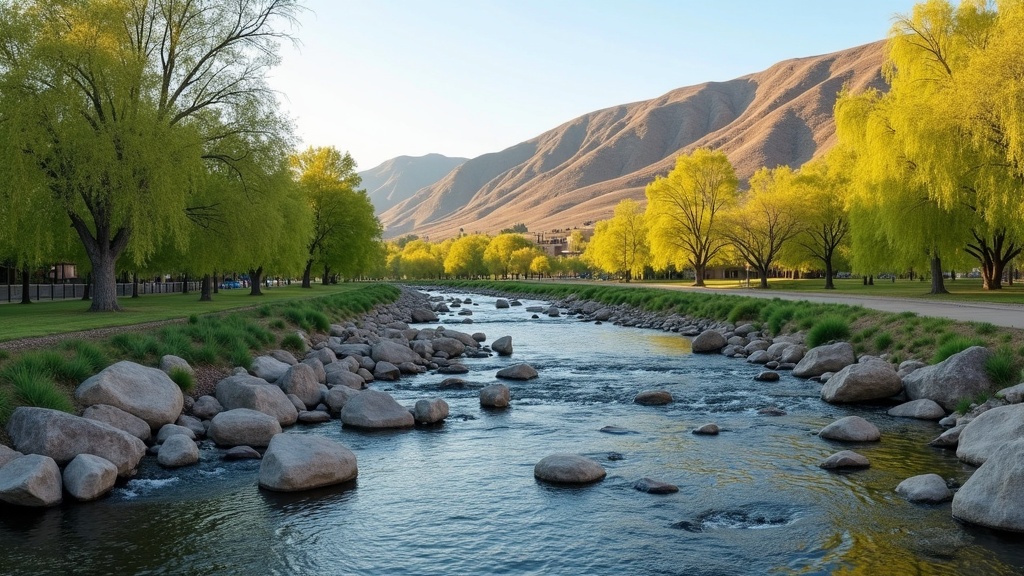
Walk the Boise River Greenbelt on any May morning and you will notice something this year: the river is running low. The banks that usually rush with snowmelt are quieter than most locals have seen in a long time. People jog past, walk their dogs, push strollers. Almost nobody stops to think about the connection between that sluggish river and the water coming out of their kitchen faucet. But there is one, and in 2026 it matters more than ever.
It Starts as Snow in the Sawtooth Mountains
Every drop of water in Boise's supply chain begins as snow falling on the Sawtooth and Boise mountain ranges. Through winter, that snowpack builds into a frozen reservoir sitting at elevation, waiting for spring warmth to release it gradually into the South Fork and Middle Fork of the Boise River.
In 2026, that frozen reservoir is smaller than it has been in over a century. Idaho is under a statewide drought emergency. Snowpack across the upper Boise River basin came in at record-low levels, and the 2025-2026 accumulation season was the warmest since 1896. Less snow means less runoff. Less runoff means less water entering the system at the top. Everything downstream feels it, including your tap.
Three Dams and a Reservoir Hold It All Together
Before any of that mountain water reaches a treatment plant, it passes through a system of dams built across the twentieth century. Anderson Ranch Dam sits furthest upstream, followed by Arrowrock Dam, and finally Lucky Peak Dam just east of Boise. Lucky Peak Reservoir is the last stop before water enters the municipal supply system.
Veolia Water Idaho operates the treatment facilities that pull from Lucky Peak and process water for much of the Treasure Valley. The treatment process handles sediment, disinfection, and basic chemistry. What it does not remove is hardness minerals. That part of the story happens somewhere else entirely.
In a low-snowpack year, Lucky Peak fills more slowly and draws down faster. Water managers have to make difficult choices about releases, and the buffer that a full reservoir provides simply is not there. The system works, but it works with less margin.
The Part Nobody Talks About: The Aquifer
Here is where most explanations of Boise's water supply stop short. The Boise River and Lucky Peak are only part of the picture. Roughly 70 to 75 percent of the water used across the Treasure Valley actually comes from the Western Snake River Plain aquifer, one of the largest groundwater systems in the American West.
This aquifer sits beneath ancient alluvial sediment: layers of gravel, sand, and volcanic rock deposited over millions of years as the Snake River and its predecessors carved the plain. As water moves through those layers, it picks up calcium and magnesium. There is no avoiding it. The geology is what it is, and the geology is made of minerals.
The result is that most homes across Boise, Meridian, Nampa, and Caldwell receive water measuring between 10 and 17 grains per gallon of hardness. That range qualifies as "very hard" by any standard water classification. Meridian consistently tests at the upper end of that range. This is not a treatment failure. It is the natural chemistry of water that has traveled through the same ancient rock that built this valley.
You see it on your showerhead. You feel it on your skin after a shower. You taste a faint flatness in your morning coffee. That is the aquifer in your glass.
How the 2026 Drought Changes What's in Your Glass
Drought does something specific to water chemistry that most homeowners do not realize. When there is less water flowing through the system, the same amount of dissolved minerals becomes more concentrated. Think of it like a cup of coffee with less water: the same amount of grounds, stronger result.
With record-low snowpack this year, aquifer recharge rates are lower. Surface water that would normally dilute groundwater is limited. The net effect is that water coming out of Treasure Valley taps in 2026 is likely carrying mineral concentrations at or near the higher end of that 10 to 17 grain range, even before summer demand peaks.
That demand is also growing in ways that are easy to miss. Meta's AI data center in Kuna draws an estimated 70,000 gallons per day from the regional water supply. Large-scale industrial water use puts additional pressure on a system already working with reduced input. More demand, less supply, same minerals: the math pushes hardness numbers up.
For your home, harder water means more scale buildup on water heaters, appliances, and fixtures. It means soap and shampoo do not lather as easily. It means dishes come out of the dishwasher with white film even after a full cycle. These are not cosmetic annoyances. Scale buildup on a water heater can cut efficiency by 20 to 30 percent and shorten its lifespan by years.
What Boise Homeowners Can Do About It
The good news is that hard water is one of the most solvable water problems there is. A whole-home water softener works by exchanging calcium and magnesium ions for sodium ions through a process called ion exchange. If you want to understand exactly how a water softener works, we have a full breakdown on that.
The right solution depends on your specific water. Hardness varies by neighborhood, by season, and by how deep your service line pulls from the aquifer. A free water test gives you actual numbers, not estimates, so any recommendation we make is based on what is actually coming out of your tap.
We test water across the Treasure Valley every week. Call us at (208) 968-2771 to schedule your free test. We will tell you exactly what your water contains and what, if anything, makes sense for your home.
Find Out Exactly What's in Your Water
Free water test across Boise, Meridian, Nampa, Caldwell, and surrounding Treasure Valley communities.